Rely on protection during direct water contact where standard desiccants fail.
Retains condensate and spray water
Reliable moisture control, even under harsh conditions
No breakage of desiccant beads
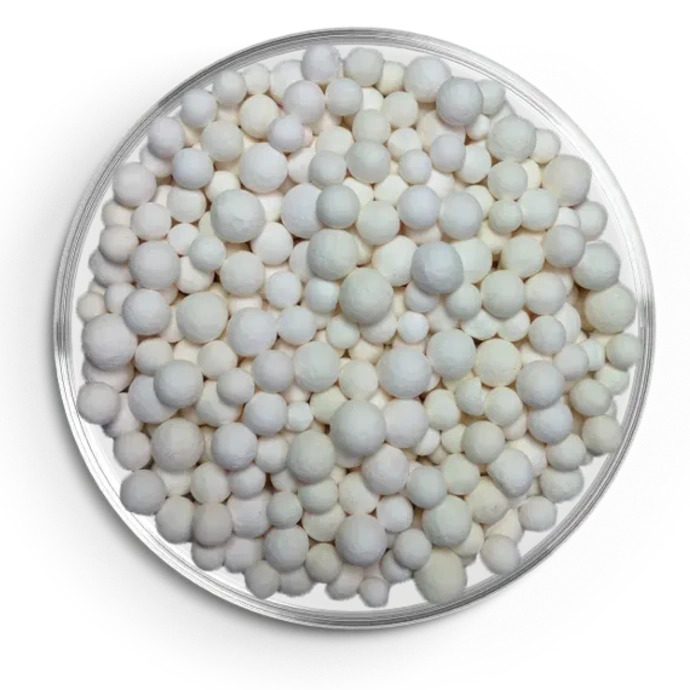
Why silica gel needs protection.
Standard silica gel beads can take up and bind almost 40% of their own weight in water molecules. That is a lot. But there is a catch: they are designed for water vapor, not for liquid water.
If the beads touch liquid water anyway, the pores flood all at once, like a crowd pushing through a narrow door. The air inside cannot escape fast enough and gets compressed. Also, heat is released because of the wetting and adds more stress. The structure begins to crack and the beads break.
The broken beads leave small, unwanted particles. Through abrasion and dust, they can put a heavy load on your plant's filtration and flow systems. Drying performance can drop, and components can be damaged.
This is how water stays out.
The answer is a second silica gel, laid as a layer on top of the standard one, like a raincoat for the bed. Splashes, condensate and humidity peaks hit this layer first. It stays intact where standard beads would break.
It is a raincoat that breathes: water vapor still passes through, and the layer even adsorbs part of it, just less than the standard gel below. What keeps it stable is either an impregnation or an Al₂O₃ content above 10 wt.%, which supports the structure. This way, the main bed underneath keeps drying, undisturbed.
Stable solutions for challenging applications.
This is where water-resistant silica gel makes the difference. As a layer on top, it keeps the condensate away from the functional desiccant layer, so nothing gets damaged. The dehumidification performance stays constantly high, even in demanding, changing environments.
Gas purification
Ensures precise dew point reduction and stable process quality without moisture-related losses.
Adsorption dryer
Protects against condensate breakthrough, regenerates efficiently, and ensures continuously dry compressed air or process gases.
Biogas & biomethane gas
Reliably dries moist biogas and protects downstream adsorbents and equipment from corrosive damage.
Protection for your process: GIEBEL Poresphere® desiccants.
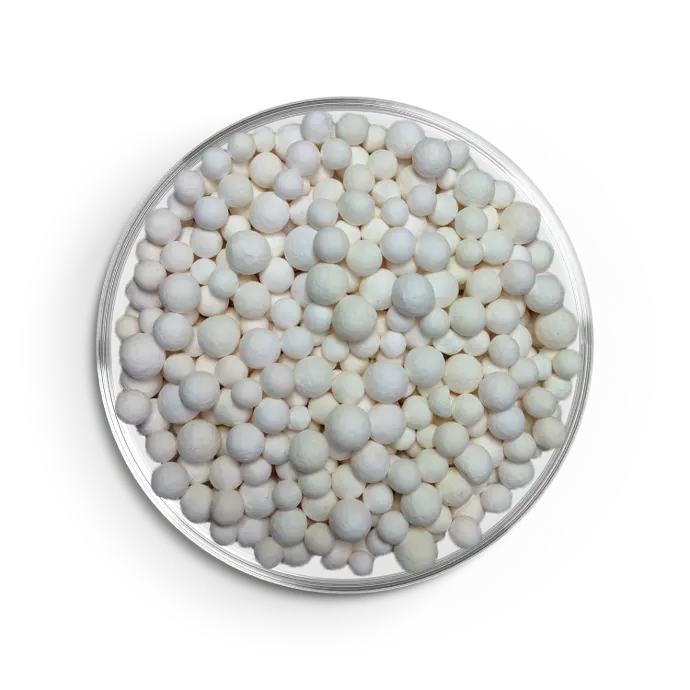
Poresphere® AL-W
Serves as protective layer
High adsorption capacity (35%)
Also adsorbs liquid water
- Structure 86.5% SiO₂, 13.5% Al₂O₃
- Grain size 3-5 mm
- Bulk density 0.749 g/ml
- Pore volume 0.42 ml/g
- Breaking strength >97 N
- Specific surface area 540 m²/g
- Abrasion rate 0.03 %
- Regeneration at 140 °C
Only 3 steps to protect your equipment.
1
Open system
Is a desiccant change due, or would you like to actively swap the mixture? Perfect!
2
Change desiccant
Fill the top 20% of the packed bed with GIEBEL Poresphere® water-resistant silica gel.
3
Protect
Protect your main desiccant for increased service life and reduced long-term costs.
Already know which product you need?
Need support choosing the right product or quantity?
FAQ - your questions, answered.
Whenever the presence of condensate, dripping water, or splashing water cannot be completely ruled out – such as in flue gas dehumidification, adsorption dryers, or outdoor installations exposed to the elements. A water-resistant top layer protects the functional main filling.
No. The protection acts exclusively on the outer surface. The adsorption function remains fully intact. Operational reliability actually increases, as damage caused by direct contact with water is prevented.
Yes, water-resistant silica gel can also be regenerated as usual, provided it has not been contaminated in other ways.
Yes. It is simply applied as a top layer. No system modification is required. The switch is quick and involves no technical adjustments.
Typical signs include broken beads, powder formation, uneven discoloration, or a premature drop in performance. If such symptoms occur, using a protective layer is worthwhile.