Dispose of desiccants and adsorbents in a professional manner.
Depending on their level of loading and area of application, spent adsorbents have different disposal requirements. Here you will find the key regulations concerning silica gel, molecular sieves, and activated alumina.

What determines the disposal route?
The permissible method of disposal depends primarily on the substances the material has adsorbed during use, rather than solely on the type of material itself.
Closed Substance Cycle and Waste Management Act (KrWG)
Adsorbents are considered waste as soon as they are intended for disposal. Their classification as hazardous or non-hazardous waste is determined in accordance with the German Waste Catalogue Ordinance (AVV).
AVV Classification
PORESPHERE® Silica Gel: AVV 06 08 99. For CAGESPHERE® molecular sieves and PORESPHERE® activated alumina, the AVV code must be coordinated with the contracted waste disposal company, and a determination must be made as to whether the material is classified as hazardous waste (indicated by an asterisk in the code).
Obligation to Provide Proof
For hazardous waste (at or above the relevant threshold), the electronic waste tracking procedure (eBNS) applies. Records of disposal and consignment notes must be retained.
REACH & CLP
Upon request, suppliers must provide information regarding ingredients and declaration requirements in accordance with Article 33 of the REACH Regulation. Classification under the CLP Regulation influences the classification of the waste.
Analyze the load before disposal
Silica gel, molecular sieves, and activated alumina are chemically inert; the substances they have absorbed determine their level of hazard. Before any disposal, the nature of the absorbed substances (e.g., solvents, hydrocarbons, heavy metals) must be documented.
Here is how to proceed with disposal.
1
Document loading and area of application
Record the type, quantity, and concentration of the substances absorbed.
2
Check for regeneration & avoid disposal
All three products are, in principle, capable of being regenerated.
3
Hazardous or non-hazardous?
A critical step—this determines the entire subsequent disposal process.
4
Engage an authorized waste management contractor
Select based on waste type, certification, and approved treatment methods.
5
Storage & transport prior to handover
Ensure secure packaging and labeling in accordance with ADR/GGVSE regulations.
6
Finalize records & documentation
Archive proof of disposal, consignment notes, and handover documentation.
Specifics for each product group.

PORESPHERE® Silicagel
SiO₂ – amorphous
Prefer modern versions that do not contain heavy-metal indicators (cobalt chloride-free / CoCl₂-free, in compliance with EU standards).
Older indicator gels containing cobalt chloride → hazardous waste (due to the presence of cobalt, a hazardous substance).
Loaded solely with H₂O:
Standard versions containing only water are non-hazardous; may be sent to a landfill or processed via thermal recovery.
Loaded with other substances:
If loaded with organic solvents → hazardous waste.

CAGESPHERE® Molekularsieb
Zeolite (Al/Si)
Loaded with H₂S:
Requires special handling; classified as hazardous waste (due to the potential for H₂S release).
Acids:
Do not bring into contact with acids (risk of structural degradation and the release of substances).
Thermal recovery:
The preferred method for heavily loaded batches.
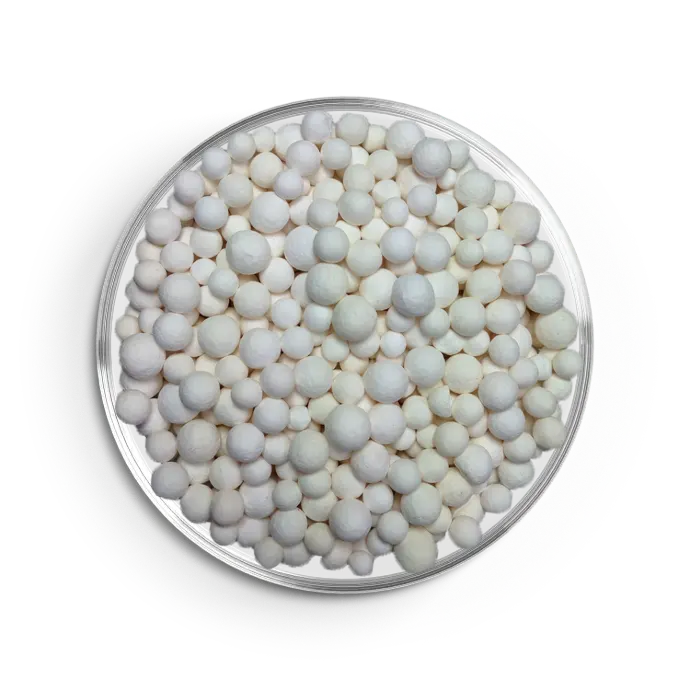
PORESPHERE® akt. Aluminiumoxid
Al₂O₃ – activated
Loaded with fluoride:
Hazardous waste (take fluoride content into account); requires separate disposal.
Loaded with arsenic:
Hazardous waste – subject to specific documentation/reporting requirements.
Uncontaminated material:
Suitable for landfill disposal, subject to eluate analysis (Al₂O₃ is generally stable).
Find an authorized waste management provider near you.
For the disposal of hazardous waste, a certified waste management company (*Entsorgungsfachbetrieb* – EfB) is required by law. The following resources will help you find the right provider in your region.
Nationwide Register of Specialized Waste Management Companies
The official register of all certified specialized waste management companies in Germany. You can search by location, radius, and type of waste. Certificates can be downloaded directly.
State-Level Hazardous Waste Agencies
Depending on the federal state, specific agencies are responsible for hazardous waste. They provide free advice on the correct classification and disposal of such waste.
AVV & Waste Catalogue
The federal government’s comprehensive waste catalogue (Abfallverzeichnis) helps you correctly classify your spent desiccant according to the German Waste Catalogue Ordinance (AVV).
FAQ - your questions, answered.
Private users: Small, uncontaminated quantities may be disposed of in household waste, provided they have first absorbed pure H₂O.
Industrial users: Dispose of large quantities in accordance with local regulations. Ensure an assessment of potential pollutants is taken into account.
Dry beads and adsorbents can be regenerated for hundreds to thousands of cycles, depending on the specific type, when loaded with pure water (H₂O) and regenerated properly. The maximum adsorbable H₂O capacity decreases more significantly in the early cycles but stabilizes at a functional level over time.
All information on regeneration can be found here:
The waste generator bears primary responsibility, but may seek advice.
AVV 06 08 99 – PORESPHERE® Silica Gel
There is no single, uniform code for CAGESPHERE® molecular sieves or PORESPHERE® activated alumina. The appropriate AVV (European Waste Catalogue) code depends on the specific application and the substances adsorbed; it must be determined on a case-by-case basis in consultation with the contracted waste disposal company.