CAGESPHERE® molecular sieves adsorb moisture & filter specific gases.
Powerful drying
Selective adsorption
Operable up to 200°C
Operable at all humidity levels
Regenerable at 300°C
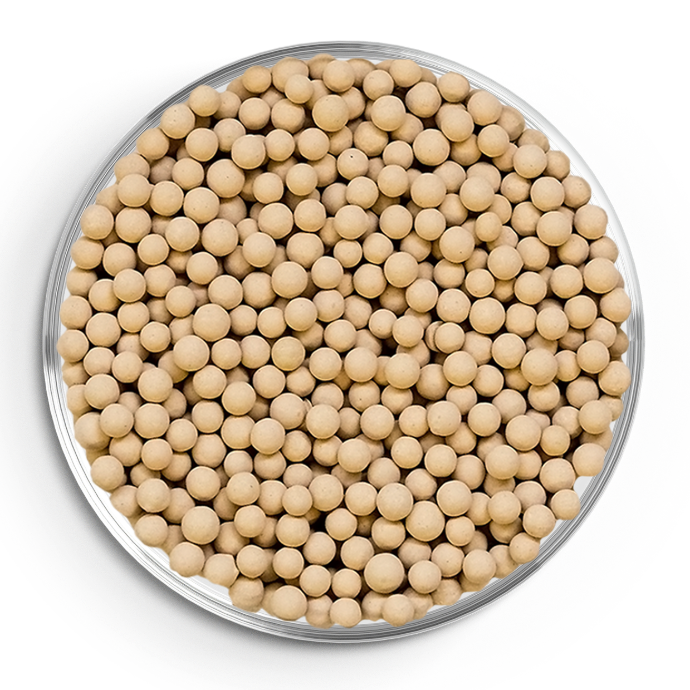
Here's how it works.
Air, gases, or solvents
Contains water vapor, CO₂, organic compounds, or other molecules that need to be removed.
CAGESPHERE®molecular sieve
Molecular sieves have precisely defined pores and an extremely large, polar surface area. They physically attract and bind water and other molecules – without the use of any chemicals.
Substances are bound
The molecules to be removed (e.g., moisture) remain bound to the surface of the granules and can be effectively retained or separated.
CAGESPHERE® Standard
Highly efficient molecular sieves.
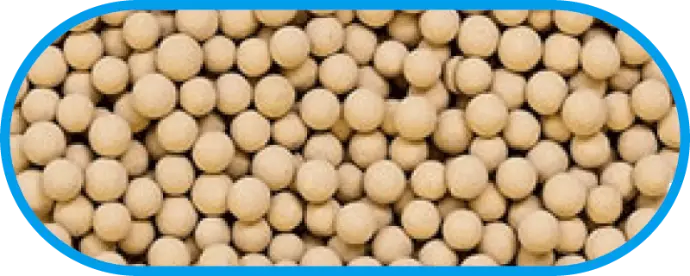
CAGESPHERE® 3A
Removal of water
Suitable for drying polar solvents
Cations K+
Actual pore size 0,30nm
Effective pore size 0,38nm
Bulk density 0,67kg/l
Pore volume 0,35-0,70ml/g
Crushing strength >70N
Specific surface area 500-1000qm/g
575°C ignition loss <1,5%
Abrasion rate <0,25%
Water absorption capacity >210ml/kg
Regeneration temperature 300°C
Buy online DISCOVER MORE
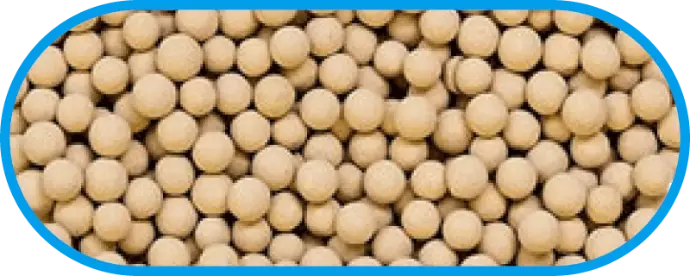
CAGESPHERE® 4A
Removal of water and carbon dioxideSuitable for drying nonpolar solvents and gases
- Cations Na+
- Actual pore size 0,42nm
- Effective pore size 0,42nm
- Bulk density 0,67kg/l
- Pore volume 0,35-0,70ml/g
- Crushing strength >80N
- Specific surface area 500-1000qm/g
- 575°C ignition loss <1,5%
- Abrasion rate <0,25%
- Water absorption capacity >230ml/kg
- Regeneration temperature 300°C
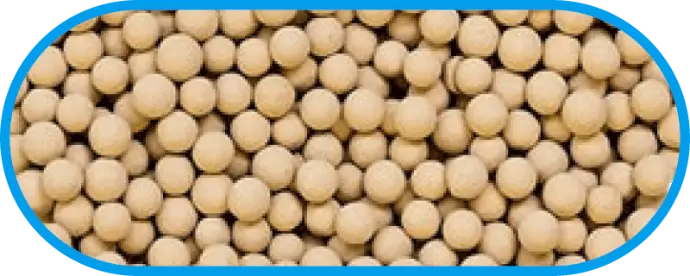
CAGESPHERE® 5A
Removal of water and carbon dioxide
Suitable for the adsorption of normal (linear) hydrocarbons up to n-C4H10, alcohols up to C4H9OH and mercaptans up to C4H9SH
- Cations Ca+
- Actual pore size 0,50nm
- Effective pore size 0,50nm
- Bulk density 0,67kg/l
- Pore volume 0,35-0,70ml/g
- Crushing strength >80N
- Specific surface area 500-1000qm/g
- 575°C ignition loss <1,5%
- Abrasion rate <0,25%
- Water absorption capacity >230ml/kg
- Regeneration temperature 300°C
Buy online DISCOVER MORE
CAGESPHERE® 13X
Removal of water and carbon dioxide
Drying and desulfurization of natural gas, liquefied gas, and liquid hydrocarbons
Suitable for drying
- Cations Na+
- Actual pore size 0,75nm
- Effective pore size 0,90.1,00nm
- Bulk density 0,60kg/l
- Pore volume 0,35-0,70ml/g
- Crushing strengtt >60N
- Specific surface area 650-1250qm/g
- 575°C ignition loss <2,0%
- Abrasion rate <0,25%
- Water adsorption capacity >210ml/kg
- Regeneration temperature 300°C
Buy online DISCOVER MORE
CAGESPHERE® Plus – binder free
For better adsorption performance.
What are binders used for?
Binders are used in production to strengthen the structure of molecular sieves—acting as a kind of adhesive on the surface between the pores.
CAGESPHERE® Plus molecular sieves do not contain any of these binders. The entire surface is fully available for absorbing moisture and other molecules.
This results in molecular sieves with a higher overall adsorption capacity. At the same time, they lose some of their dimensional stability due to the absence of the binder.
CAGESPHERE® Plus-3A
Binder-free – higher adsorption capacity
Water removal
Suitable for drying polar solvents
- Pore size: 0,3 nm
- Particle size : 2,5-5,0 mm
- Mesh: 4x8
- Bulk density: 650-750 g/l
- Abrasion rate: 0,20 %
- Crushing strength: 40N
- Water content: 1,0 %
- Water adsorption capacity: ≥24%
- Regeneration temperature: 300°C
Buy online DISCOVER MORE
CAGESPHERE® Plus-4A
Binder-free – higher adsorption capacityRemoval of water and carbon dioxide
Suitable for drying nonpolar solvents and gases
- Pore size: 0,40 nm
- Particle size: 1,6-2,5 mm oder 2,5-5,0 mm
- Mesh: 8x12 oder 4x8
- Bulk density: 620-700 g/l
- Abrasion rate: 0,20 %
- Crushing strength: 25 N oder 115N
- Water content: 1,0 %
- Water adsorption capacity: ≥24%
- Regeneration temperature: 300°C
CAGESPHERE® Plus-5A
Binder-free – higher adsorption capacityRemoval of water and carbon dioxide
Suitable for the adsorption of normal (linear) hydrocarbons up to n-C4H10, alcohols up to C4H9OH, and mercaptans up to C4H9SH
- Pore size: 0,5 nm
- Particle size: 2,5-5,0 mm
- Mesh: 4x8
- Bulk density: 620-700 g/l
- Abrasion rate: 0,20 %
- Crushing strength: 40N
- Water content: 1,0 %
- Water adsorption capacity: ≥24%
- Static N2 adsorption capacity: ≥9,5 cm³
- Regeneration temperature: 300°C
Buy online DISCOVER MORE
CAGESPHERE® Plus-13X
Binder-free – higher adsorption capacityRemoval of water and carbon dioxide
Drying and Desulfurization of Natural Gas, Liquefied Petroleum Gas, and Liquid Hydrocarbons
Suitable for drying HMPT
- Actual pore size: 0,74 nm
- Particle size: 1,6-2,5 mm
- Mesh: 8x12
- Bulk density: 595-675 g/l
- Crushing strength: 25 N/Stück
- Abrasion rate: 0,20 %
- Static CO2-adsorption: ≥30 %
- Water content: 1 %
- Regeneration temperature: 300°C
Buy online DISCOVER MORE
Are you looking to adsorb specific chemical substances?
Find out which CAGESPHERE® molecular sieve selectively adsorbs which substances – Overview.
What sets CAGESPHERE® molecular sieves apart?
Selective adsorption
Only molecules smaller than the pores of the molecular sieve are adsorbed.
Extremely low residual moisture
Achieve residual humidity in the ppm range with dew points as low as -70°C. Thorough drying down to the finest detail.
Renewable & durable
By heating it gradually to 300°C, the moisture can be removed again.
Molecular sieves with A and X structures.
CAGESPHERE® Type A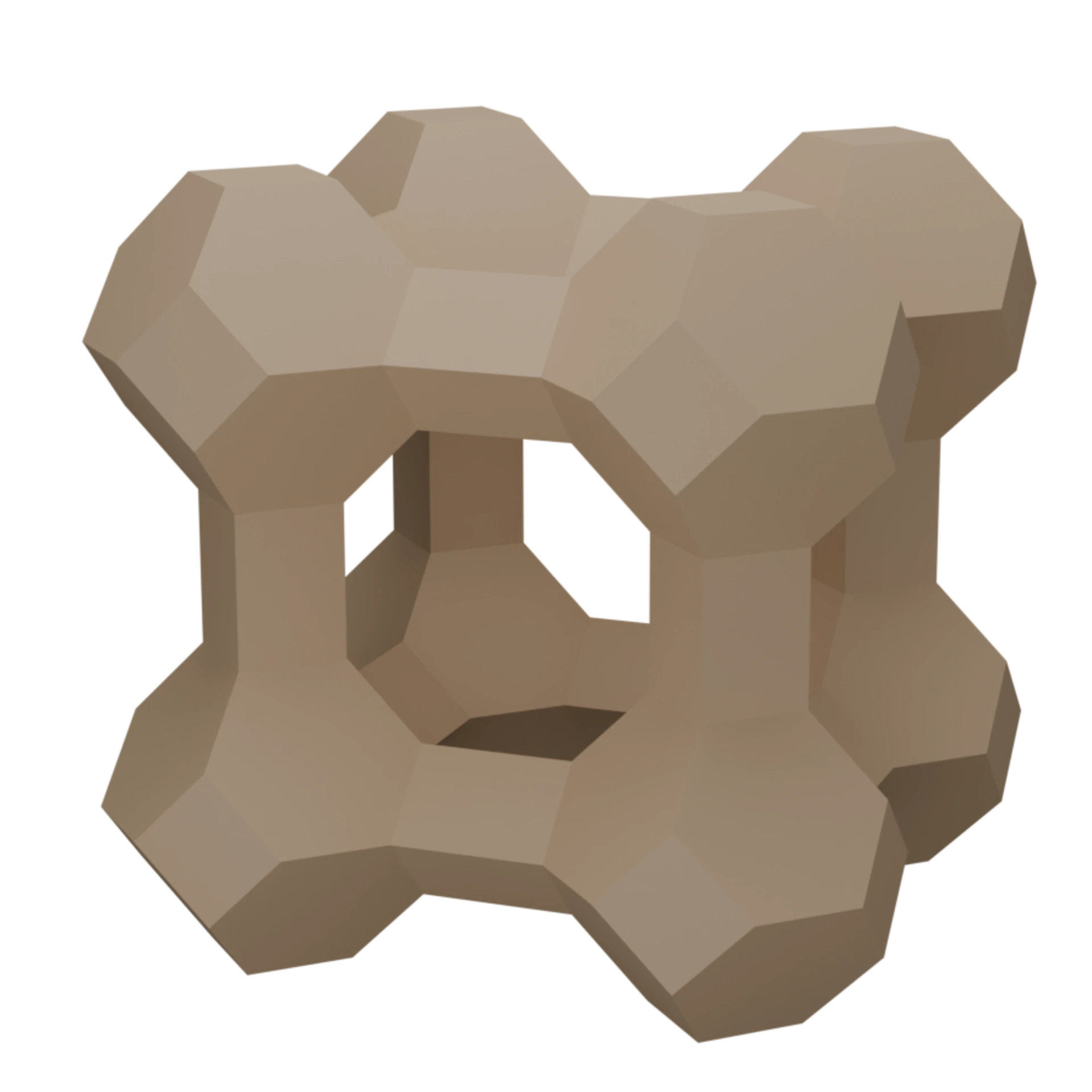
Simple Linde Type A crystal structure
Smaller pores
Tailored adjustment depending on the application
CAGESPHERE® Type X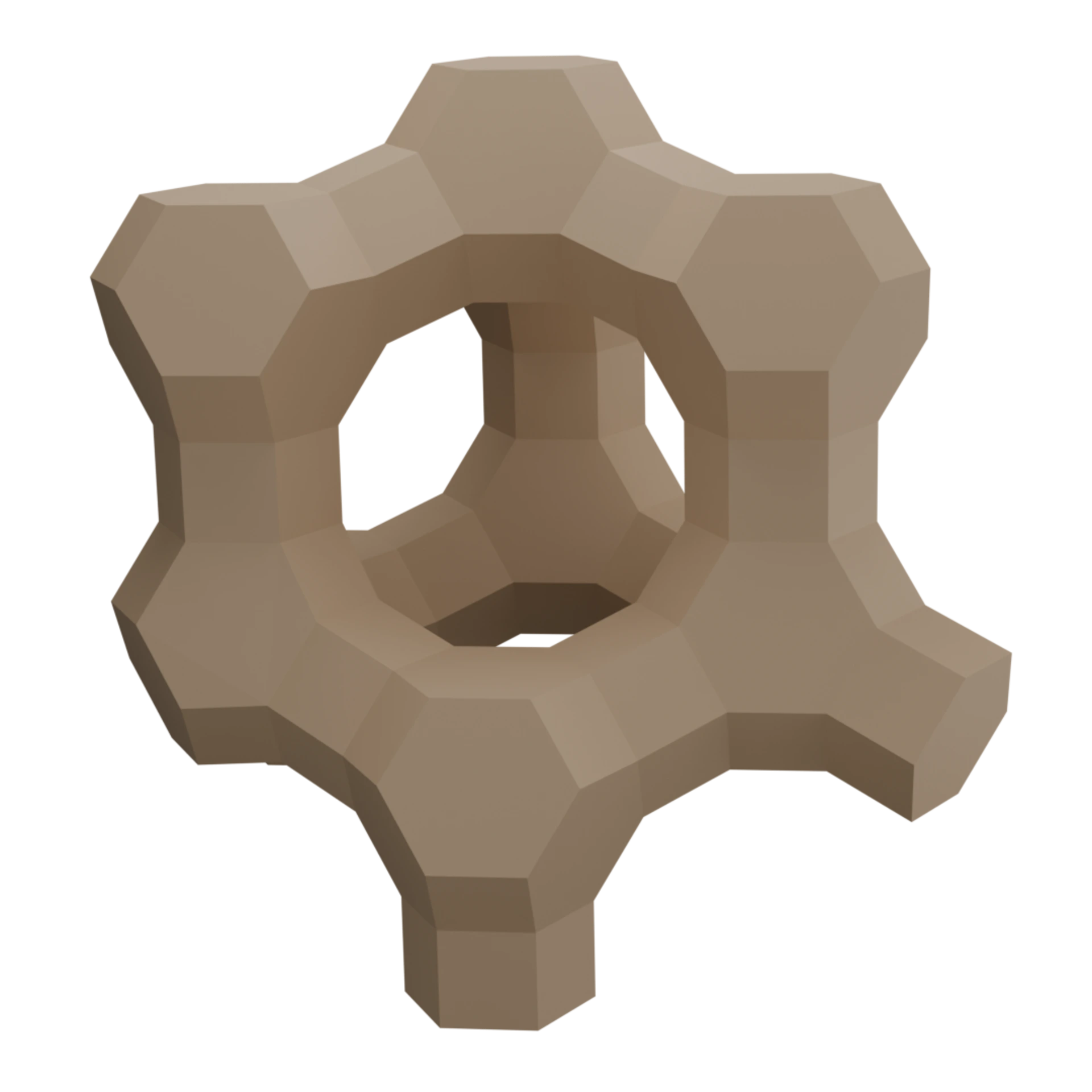
Complex faujasite cage structure
Greater moisture retention, higher overall capacity
Broad adsorption spectrum – even for larger molecules
Particle Sizes – Which is right for which application?
CAGESPHERE® molecular sieves are available in two standard particle sizes, which significantly influence their adsorption properties.
1,6 – 2,5 mm
Fast adsorption, low volumes
Adsorption happens rapidly because the molecules have shorter paths to travel and quickly come into contact with the internal surface. However, with finer particle sizes, both the pressure drop in the gas stream and the potential wear on the beads increase.
3,0 – 5,0 mm
High volumes, robust
Coarser grit sizes achieve a moderately fast adsorption rate, but are significantly more mechanically stable and, thanks to lower resistance, cause virtually no pressure drop or abrasion in the system.
Applications.
Already know which product you need?
Need support choosing the right product or quantity?
FAQ - your questions, answered.
Die Wasseraufnahme von Molekularsieben hängt vom jeweiligen Typ, der Korngröße und den Umgebungsbedingungen ab. Unsere Produkte können bis zu 25% ihres Eigengewichts an Wasser in einer vollständig gesättigten Umgebung adsorbieren. Das bedeutet: 1kg Molekularsieb kann je nach Einsatzbedingungen bis zu 250g Wasserdampf binden.
Die Molekularsieb-Typen 3A, 4A, 5A und 13X unterscheiden sich hauptsächlich durch ihre Porengröße und damit durch die Selektivität für bestimmte Moleküle, die sie adsorbieren können. Typ 3A besitzt die kleinste Porenstruktur (ca. 3 Ångström) und adsorbiert ausschließlich Wassermoleküle – ideal zur Feuchtigkeitsentfernung, ohne andere Substanzen wie Ethylen zu beeinflussen. Molekularsieb 4A (ca. 4 Å) ist universeller einsetzbar und bindet neben Wasser auch kleinere Moleküle wie Ammoniak, CO₂ oder Methanol. Es eignet sich besonders gut zur Luft- und Gastrocknung. Typ 5A (ca. 5 Å) kann zusätzlich n-Alkane und lineare Kohlenwasserstoffe aufnehmen, was ihn ideal für Molekültrennungen und Anwendungen wie die Erdgas- oder Wasserstoffaufbereitung macht. Molekularsieb 13X hat mit ca. 10 Å die größten Poren und kann auch größere Moleküle wie Aromaten, Schwefelverbindungen oder CO₂ adsorbieren. Es bietet die höchste Adsorptionskapazität und wird häufig in der Luftreinigung und Biogasaufbereitung eingesetzt.
The choice of the right molecular sieve ultimately depends on the desired target substance, operating conditions, and application. While Type 3A is optimal for pure moisture removal, Types 5A and 13X offer more advanced capabilities for selective molecular separation and gas conditioning. For a detailed overview, we have provided a separate table:
Nein, unsere Molekularsiebe haben im Gegensatz zum Silicagel keinen Farbindikator.
Molekularsiebe lassen sich vollständig regenerieren, nachdem sie mit Feuchtigkeit oder anderen adsorbierten Molekülen gesättigt wurden. Das ist einer ihrer größten Vorteile gegenüber anderen Trockenmitteln wie Silikagel oder Aktivkohle. Die Regeneration erfolgt durch Wärmezufuhr (thermische Regeneration).
Hierbei wird das Molekularsieb auf 300°C erhitzt, um die adsorbierten Moleküle – meist Wasserdampf – aus dem Porensystem zu lösen. Dieser Prozess ist vollständig reversibel, da Molekularsiebe eine sehr stabile kristalline Struktur besitzen und ihre Adsorptionsfähigkeit auch über viele Zyklen hinweg erhalten bleibt. Da die Bindungskräfte in der Kristallstruktur so stark sind, dass Wassermoleküle erst bei diesen Temperaturen freigegeben werden, entfällt jedoch die Möglichkeit zur sogenannten Eigenregeneration. Das bedeutet, dass ein Freispülen des gebundenen Wassers mit der getrockneten Zuluft im Zuge der zyklischen Atmung einer Anlage oder eines Behälters ohne Zufuhr von Wärme effektiv nicht möglich ist.
Molekularsiebe sind extrem hygroskopisch – das heißt, sie ziehen Feuchtigkeit aus der Umgebungsluft an. Um ihre Adsorptionsfähigkeit zu erhalten, ist eine sachgerechte Lagerung unerlässlich. Bereits geringe Mengen an Luftfeuchtigkeit können die Poren der Siebe ungewollt belegen und damit ihre Wirkung beeinträchtigen oder vollständig blockieren: Trocken lagern, Verpackung beachten, Temperaturkontrolle und Lagerortbedingungen beachten.
Should unwanted moisture ingress occur, molecular sieves can be fully reactivated through thermal regeneration.
Yes, we offer discounts for orders above 1ton. As a bulk customer, feel free to contact us directly by phone, email, or through our contact form.