Desiccants in biogas production.
Moisture poses a problem for the plant and pipelines during biogas processing. To prevent damage, drying stages containing desiccants are installed at various points, depending on the process.

Biogas production process.
Following fermentation in the digester, biogas exists initially as a raw gas mixture, containing primarily methane, CO₂, water, and trace substances such as H₂S.
To be utilized as an energy source, it must first be cleaned and processed.
Adsorption processes
Adsorbents such as activated carbon, silica gel, aluminum oxide, and molecular sieves bind H₂S, H₂O, CO₂, and other gas components to their surfaces.
Membrane processes
A membrane with varying permeability is used to separate specific gas components, such as H₂O, NH₃, and H₂S.
Washing (scrubbing) processes
In pressurized water scrubbing and amine scrubbing, gas components dissolve in water or an amine solution and are subsequently washed out.
The result is processed biogas.
When are desiccants used?
Pre-drying
Regardless of the method chosen, pre-drying the raw gas may be necessary to protect downstream process steps.
Excess moisture can cause long-term damage due to corrosion within pipelines and the biogas plant itself.
In the case of membrane-based processes, pre-drying also serves to protect the membranes being used.
Post-drying
Post-drying is necessary if the biogas still contains too much moisture following the primary separation stage.
This step is particularly essential for scrubbing (washing) processes, as the required dew points at the outlet could otherwise not be achieved.
How does gas drying work?
For the drying process, the moist gas stream is passed through a container filled with a desiccant.
In this process, the desiccant granules bind water molecules to their porous surface, actively removing moisture from the gas mixture.
The water molecules remain trapped within the granules, while the gas mixture exits the container in a dry state.
Vortrocknung
Unabhängig des gewählten Verfahrens kann eine Vortrocknung des Rohgases notwendig sein, um die folgenden Prozessschritte zu schützen.
Zu viel Feuchtigkeit kann in Rohrleitungen und im Inneren der Biogasanlage zu langfristigen Schäden durch Korrosion führen.
Beim Membranverfahren dient die Vortrocknung ebenfalls dem Schutz der eingesetzten Membran.
Nachtrocknung
Eine Nachtrocknung ist dann notwendig, wenn das Biogas nach der Haupttrennung noch zu viel Feuchtigkeit aufweist.
Besonders bei Waschverfahren ist dieser Schritt essentiell, da die geforderten Taupunkte am Ausgang sonst nicht erreicht werden können.
Upgrading to biomethane.
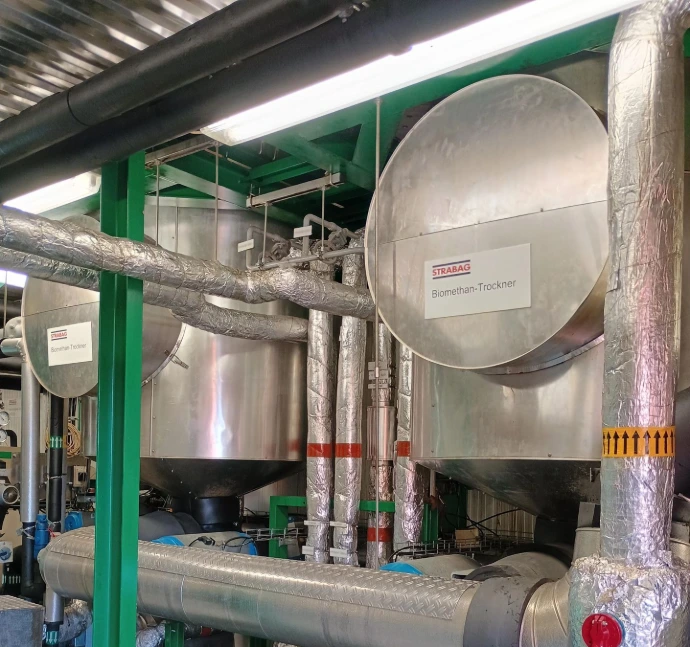
If the biogas is used solely for an on-site combined heat and power (CHP) plant, the primary focus is on basic purification to make it suitable for engine operation.
However, if it is to be fed into the public natural gas grid, stricter regulations apply, and the biogas must undergo an additional processing step to become biomethane.
This requires achieving a specific gas composition that adheres to clearly defined limit values.
The suitable desiccants for gas drying.
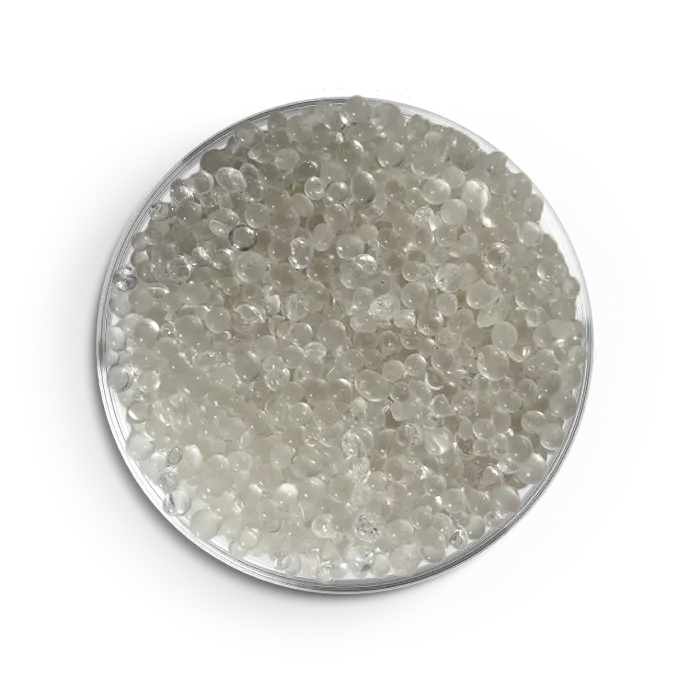
PORESPHERE® AL-H
Desiccant, alumina-silica gel
High-capacity SiO₂ granules (silica gel) used as a primary drying stage. Reliably removes water vapor from gas mixtures and protects downstream catalysts, activated carbon, or molecular sieves.
Particle size: 3–5 mm spheres
BET-surface area: ≥ 729 m²/g
H₂O-capacity: ≥ 44% (at 80% RH)
Regeneration temp.: 140 °C
Dew point to: –40 °C
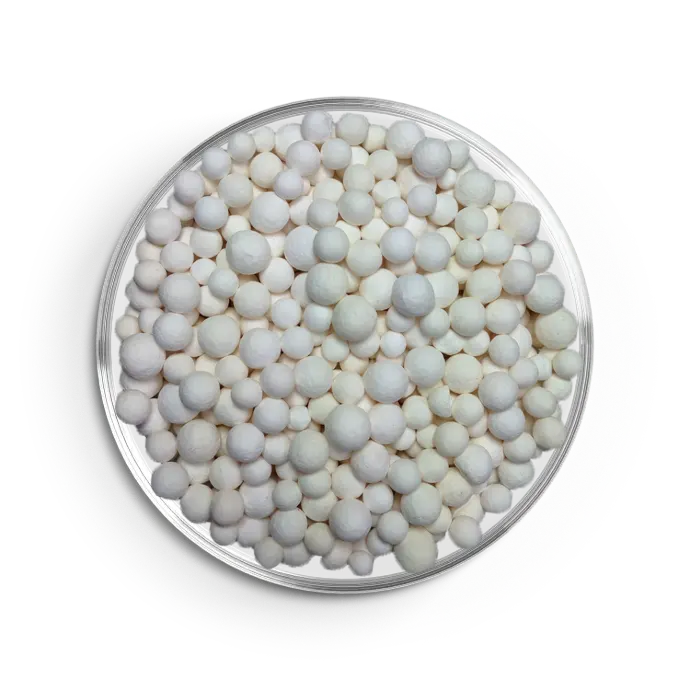
PORESPHERE® Aktiv-AL
Desiccant, activated alumina
Activated alumina granules designed for use under demanding conditions. Reliably removes water vapor from gas mixtures and withstands high volumetric flow rates.
Particle size: 3–5 mm Kugeln
BET-surface area: ≥ 320 m²/g
Regeneration temp.: 200 – 220°C

PORESPHERE® AL-W
Protective layer against condensation, alumina-silica gel
SiO₂ granules (silica gel) with a high Al₂O₃ content, designed for protection against condensation. Maintains structural integrity upon contact with liquid water and protects downstream catalysts, activated carbon, or molecular sieves.
Particle size: 3–5 mm spheres
BET-surface area: ≥ 540 m²/g
H₂O-capacity: ≥ 34% (at 80% RH)
Regeneration temp.: 140 °C

CAGESPHERE® 13X
CO₂ scrubber & desiccant, molecular sieve
Zeolite-based molecular sieve with a defined pore size of 10 Å. It eliminates CO₂ to ≤ 1 ppm and effectively adsorbs CO₂ and O₂ – the critical impurities that stand between raw biogas and upgraded biomethane.
Pore size: 10 Å (1,0 nm)
CO₂-capacity: ≥ 17%
H₂O-capacity: max. 25%
Crushing strength: ≥ 80 N/piece
Life-time: 8–10 years