Adsorbents for air separation units.
How molecular sieves and activated alumina reliably secure the critical air purification step. And why choosing the right adsorbent determines both product purity and operating costs.
How a cryogenic air separation plant works.
1
Air intake & pre-filtration
G4 particulate filters capture dust ≥5 µm.
2
Compression
Multi-stage centrifugal compressor, aftercooling to 5–10°C.
3
Deep purification via molecular sieve
H₂O, CO₂, and hydrocarbons are adsorbed.
4
Cryogenic cooling
Heat exchangers, turbine expanders, partial liquefaction.
5
Distillation in separation columns
Double-column system, utilizing the boiling point differences between O₂, N₂, and Ar.
6
Extraction & storage
Liquid and gaseous products stored in insulated tanks.
3. Deep Purification – The Critical Step
Compressed air contains water vapor, CO₂, and traces of hydrocarbons such as acetylene. In the cryogenic section, these impurities would solidify, clogging pipelines, impairing the heat exchanger – and in the worst-case scenario, leading to the formation of explosive acetylene accumulations.
The adsorber (utilizing Temperature Swing Adsorption, or TSA) employs a dual-bed system consisting of two layers of material:
Application of Our Adsorbents
Layer 1 – Activated Alumina (Al₂O₃): Adsorbs the majority of the water vapor (achieving a dew point down to –70 °C). This protects the downstream molecular sieve from being overloaded by moisture.
Layer 2 – Molecular Sieve 13X: Removes CO₂ to a level of ≤ 1 ppm and acetylene to ≤ 0.1 ppm. Its defined pore size (10 Å) ensures highly selective adsorption of these critical impurities. Service life: 8–10 years.
The appropriate adsorbents for ASUs.
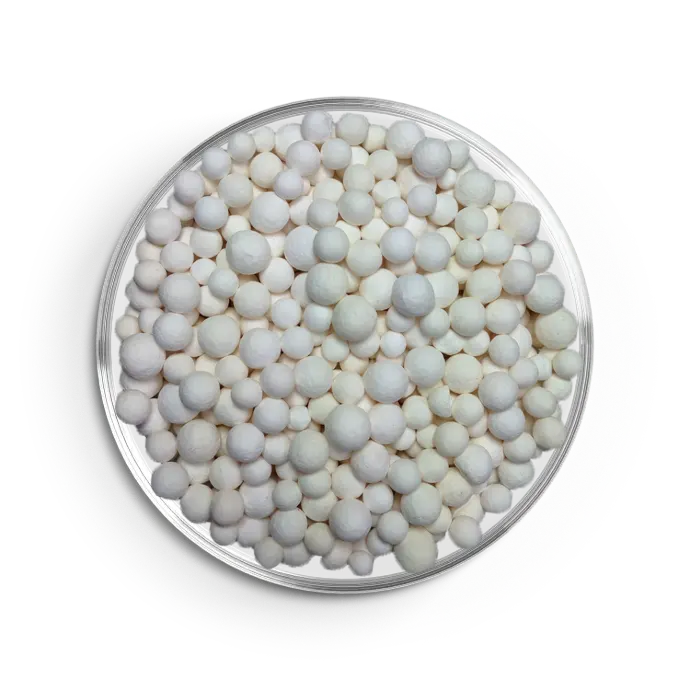
PORESPHERE® Aktiv-AL
Desiccant • Precoat
High-capacity Al₂O₃ granules as the first adsorbent layer in the TSA adsorber. Reliably removes water vapor from the compressed air, protects the downstream molecular sieve and thus extends the entire operating time of the adsorber.
Dew point reaching: -70 °C

CAGESPHERE® 13X
CO2 & KW separator • Main layer
Zeolite-based molecular sieve with defined pore size 10 Å. Removes CO₂ and acetylene. Prevents contaminants that can solidify in the system.
Regeneration gas: hot nitrogen
What happens without the right adsorbent?
Heat exchanger blockage
Water vapor and CO₂ freeze out at cryogenic temperatures, clogging the narrow channels of the plate-fin heat exchanger. The result: pressure drop, reduced efficiency, and unplanned downtime.
Acetylene accumulation
Hydrocarbons such as acetylene accumulate in the liquid oxygen phase. At concentrations above 0.5 ppm, there is a risk of explosion. That´s a safety-critical scenario.
Product contamination
Residual CO₂ in the distillation column impairs the purity of the final product. In the electronics industry, where 99.9999% N₂ purity is required, this can lead to the rejection of entire batches.
Shorter regeneration cycle
An inferior adsorbent with low capacity requires more frequent regeneration. More frequent regeneration leads to higher nitrogen consumption and increased energy demand.
Adsorbent selection by process type.
Which product is suitable for which system?
Process type | PORESPHERE® Aktiv-AL | CAGESPHERE® 13X |
|---|---|---|
Large-scale cryogenic ASU | Pre-layer | Main layer |
PSA nitrogen | Optional | Optional |
VPSA oxygen | No | Yes |
Membrane separation | Pre-drying | No |
Biogas upgrading | Optional | Yes |
Our recommendation
For large-scale cryogenic plants, we always recommend the combination of PORESPHERE® Activated Alumina + CAGESPHERE® 13X in a dual-layer bed for optimal CO₂ profiling and maximum operational lifespan.