Molecular sieves in cyclic regeneration processes.
How to regenerate molecular sieves in industrial drying processes: desorption principle, timing, and regeneration methods.
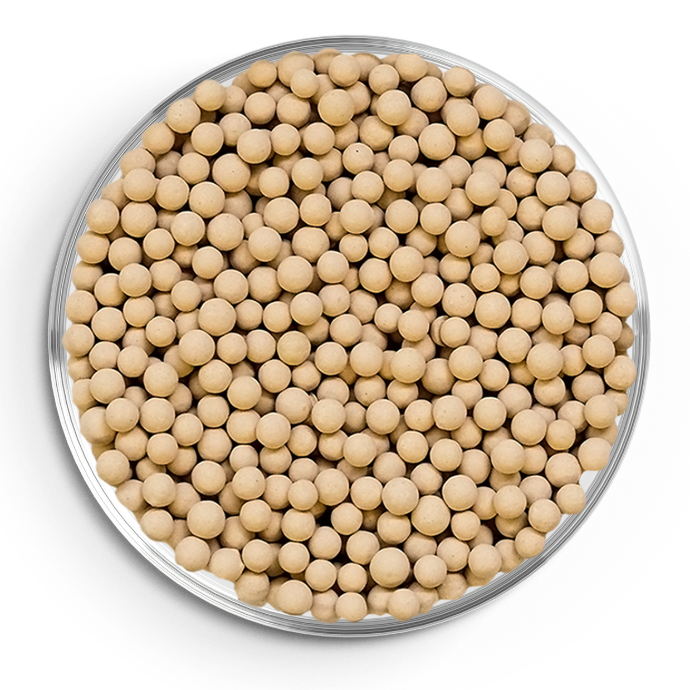
Molecular sieves bonds are reversible.
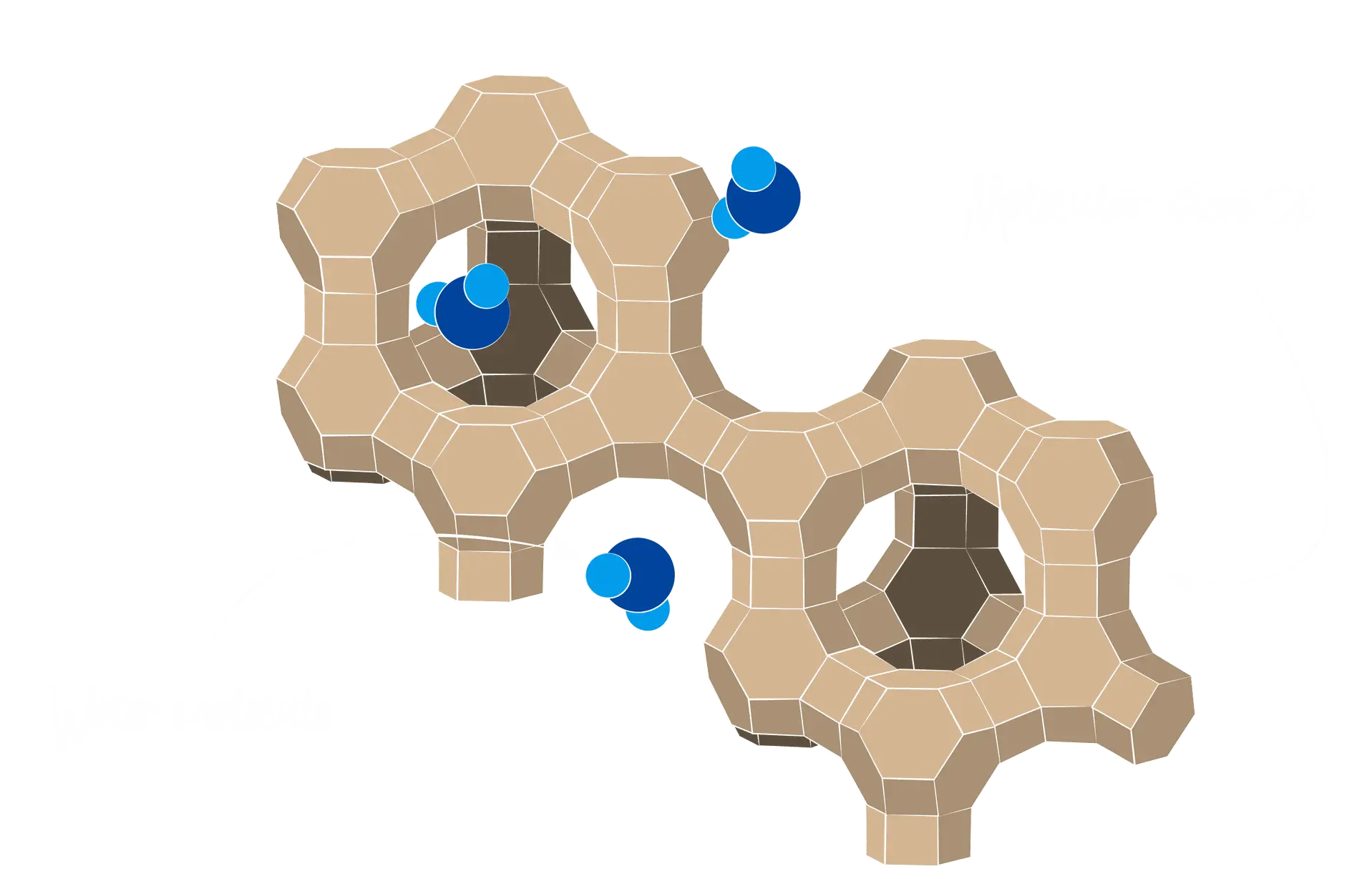
A molecular sieve holds molecules without changing them, and without changing itself. Inside its pores, the molecules stick through weak physical forces, not through a chemical reaction. Water is held most firmly, but the same principle works for other gases and vapors, like CO₂ for example.
Because nothing reacts, the process can simply be run backwards. Add heat or lower the pressure, and the molecules leave the pores again. The crystal structure itself stays as it was, so the sieve is ready for the next round.
That is why molecular sieves work in repeated cycles of adsorption and desorption, whether the job is drying a gas or removing another component from a gas stream.
When is regeneration due?
A adsorbent bed never fills up with water or other components all at once. The loading creeps forward slowly. The beads at the inlet saturate first, and the zone where the adsorption happens slowly moves toward the outlet. The adsorption cycle should end when this zone reaches the end of the adsorbent bed and the targeted component starts to break through.
To identify this point we will need to know how much of the bed is already saturated. There are four different options.
If the outlet dew point no longer reaches the required dew point when drying, it is likely time for regeneration.
Pressure drop
Similar to dew point measurement, a drop in system pressure can also signal a saturated adsorbent bed.
The molecular sieve filling is replaced cyclically based on empirical data and the expected load.
Electronic humidity sensors can measure rising humidity levels in closed systems – indicating if the beads are not sufficiently drying anymore.
How are molecular sieves regenerated?
Thermal regeneration
Heating molecular sieves to 300 °C is enough to break the molecular bonds and loosen most potential components from the beads pores.
To achieve full regeneration, the entire packed bed must be heated uniformly right through to the core.
Usually, a stream of hot, dry gas is passed through the adsorbent bed. It gives the adsorbed molecules the energy to leave the surface and carries them out of the container.
Pressure reduction
Regeneration does not neccessarily need heat – only less pressure.
On the bead surface, molecules constantly leave and return. What tips the balance is how much vapor is floating around the beads. Lower the total pressure, and the vapor pressure drops with it, so fewer molecules return than leave.
Then, flushed with a little dry gas, the bed dries out.
Regeneration applied to industrial standards.
Thermal regeneration and pressure reduction describe two physical processes used to release molecules from the surface pores of molecular sieves. In industrial applications, these principles are utilized to construct cyclic processes.
Are my beads dry enough?
Just as you can check when your adsorbent is saturated and needs to be regenerated, there are ways to determine whether the regeneration itself was successful or not.
If molecular sieves are only partially regenerated, this quickly manifests as shorter cycle intervals. Residual moisture or other components remains in the granules, reducing the maximum capacity during the following adsorption cycle.
Electronic humidity sensors can measure rising and sinking humidity levels in closed systems – indicating if the beads are dry enough.
After regeneration, a gas stream is passed through the molecular sieve bed which needs to reach the desired dew point.
Gas concentration
If specific substances are to be removed from a gas stream, the initial purity can be determined. Regenerated material must meet the target values.
Setpoint comparison
Many systems rely on fixed cycle times with standardized reference values. If the planned service life is not achieved, this indicates ineffective regeneration.
Can molecular sieves be reused endlessly?
Regeneration brings a molecular sieve back, but never quite all the way. Each cycle leaves a small permanent loss, for two reasons.
The cycle itself is hard on the crystal structure: heating and cooling cause thermal stress, and the water leaving the beads as hot steam slowly damages the crystal structure.
Not everything that was adsorbed leaves again. Oil, heavy hydrocarbons or reactive olefins can turn into coke at regeneration temperature and block pores for good.
The loss is steepest at the start. Under good conditions, the maximum water adsorption capacity falls to about 80 % of its starting capacity within 500 cycles, then the curve flattens.
For CAGESPHERE® 4A, that is about 230 ml of water per kg fresh and about 184 ml after 500 cycles. Counting cycles, not calendar time, tells you where a bed stands, so size it for its aged capacity.
Already know which product you need?
Need support choosing the right product or quantity?
FAQ - your questions, answered.
Yes, you can regenerate smaller amounts of molecular sieves at home as well.
- Heat your oven to 300 °C
- Spread the beads out across a baking sheet
- Bake for 5–6 hours
- Let the beads cool down and fill them into an airtight container
If your oven cannot heat up to 300 °C, your molecular sieve beads will not be fully regenerated but still reusable.