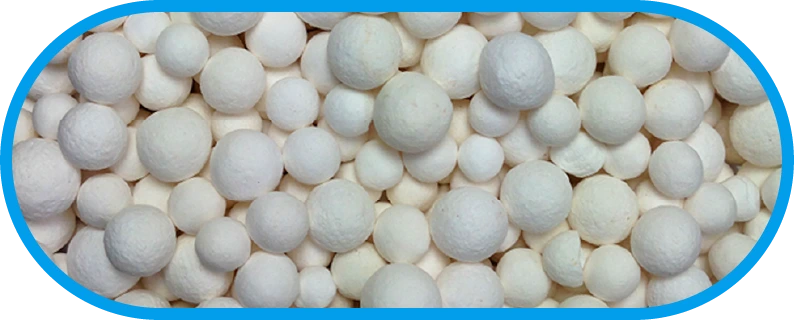
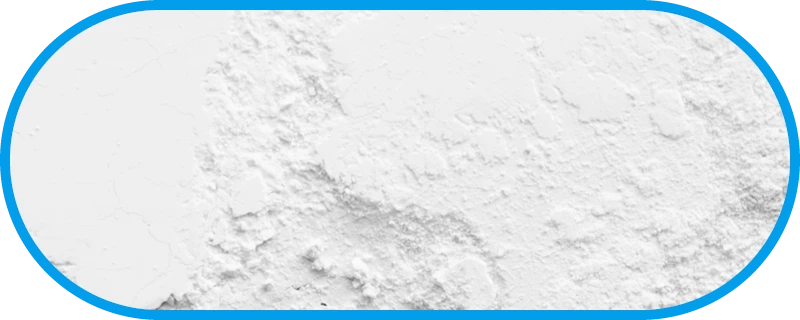
Activated alumina: desiccant, adsorbent, and catalyst carrier rolled into one.
These granules come with multiple talents. Discover how their manufacturing process and unique surface chemistry make them ideal for quite a few industrial applications.
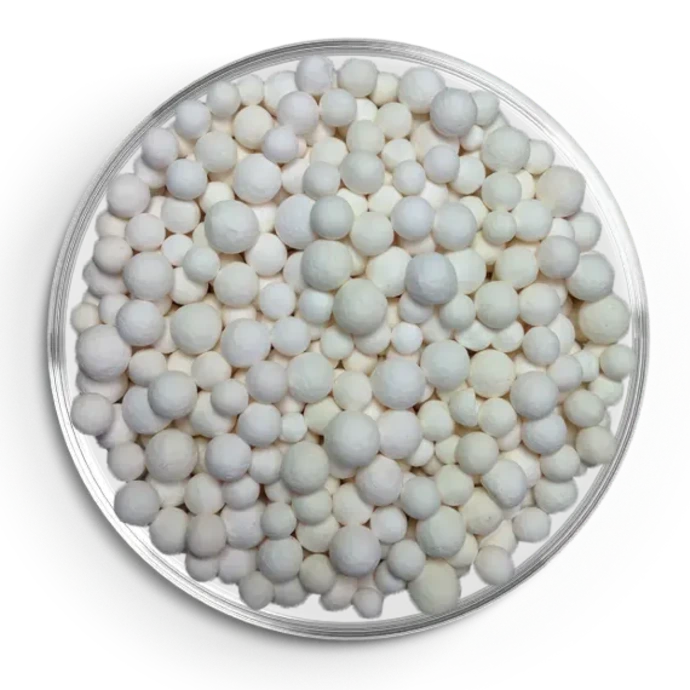
What is activated alumina?
As the name suggests, these small spheres consist primarily of aluminum oxide (Al₂O₃). During production, the raw material bauxite is processed into aluminum hydroxide powder, which is then pressed into spheres and heated to temperatures between 400°C and 600°C. The intense heat causes the water content to evaporate so rapidly that it leaves behind countless tiny pores and robust internal cavities.
These pores create a surface area of up to 330 m² per gram of material – equivalent to more than an entire tennis court packed onto a fingertip. This surface area allows various molecules, such as water or pollutants, to bind to the material.
Thanks to these unique properties, activated alumina is used in a range of industrial applications. For instance, as a robust desiccant, as an adsorbent for capturing substances like acidic gases or as a catalyst carrier.
Bauxite
Aluminum hydroxide powder
Activated alumina
How are molecules taken up?
Adsorption
= physical interactions
Molecules penetrate the pores on the surface, where they are held in place by physical interactions (physisorption).
Polar water molecules, in particular, form a temporary bond with the polar surface due to electrostatic attraction.
Since it is a physical process – like a kind of magnetic bond – it is reversible by supplying energy. The previously absorbed molecules can be driven out, allowing the granules to be reused.

Typical applications for activated alumina
Activated alumina is a versatile desiccant that is indispensable in many industrial processes. It reliably protects against damage caused by unwanted moisture while simultaneously acting as a filter medium by selectively adsorbing specific molecules.
Adsorption dryers
Adsorption dryers are frequently used when large industrial volumes of air or gas need to be dried.
The systems consist of two interconnected containers filled with desiccant to dry the gas/air mixture flowing through them.
Fluoride Removal
Raw water sometimes contains excessively high fluoride concentrations. During drinking water treatment, this fluoride must be removed.
Activated alumina binds the fluoride ions dissolved in the water, ensuring a safe drinking water supply.
Ethylene Removal
Ethylene is released during the natural ripening process of fruit. In sealed packaging, it accumulates and accelerates the ripening of surrounding produce.
Activated alumina treated with potassium permanganate adsorbs and oxidizes the ethylene, thereby preventing premature ripening.
As desiccant.
Activated alumina offers good moisture absorption but falls somewhat outside the category of standard desiccants. Due to its robust properties, it is primarily used in industrial settings for gas drying or in adsorption dryers, where the beads must withstand demanding process conditions.
Property | Clay (Bentonite) | Calcium chloride | Silica gel | Molecular sieves | Activated alumina |
|---|---|---|---|---|---|
Application | Dehumidification | Dehumidification | Dehumidification | Selective adsorption, deep drying | Selective adsorption, robust properties, deep drying |
Moisture absorption | Moderate (~20%) | Very high (~200%) | High (~35%) | Moderate (~25%) | Moderate (~20%) |
Form during adsorption | Swells | Liquefies | Unchanged | Unchanged | Unchanged |
Reaction with other substances | Forms chemical compounds | Forms chemical compounds | Chemically inert | Chemically inert | Chemically inert |
Reusable | Regenerable | No | Regenerable | Regenerable | Regenerable |
An overview of the details.
H₂O adsorption capacity (25 °C)
RH = 30% 11%
RH = 60% 22%
RH = 80% 30%
Regeneration
Temperature 200 – 220 °C
Duration 2–4 hours
Specifications
Pore volume 0,5 ml/g
Spec. surface area 330 m²/g
Crushing strength 160 N/piece
As adsorbent.
Activated alumina is chosen when you want to remove specific dissolved or gaseous contaminants that have a strong affinity for its surface chemistry and pore structure.
Surface chemistry
Its surface is covered with hydroxyl groups (–OH) that can react or bind with certain ions and polar molecules.
Pore structure
It has a mix of micro-, meso-, and macropores that allow good access for molecules while offering lots of surface area for them to stick to.
What substances are adsorbed?
Fluoride (F⁻)
Arsenic (As(V), pentavalent)
Phosphate
Oxyanions
Sulfur compounds
Why these? Because they are either:
- Charged or highly polar, so they interact strongly with the polar, hydroxylated alumina surface
- Small enough to enter the mesopores and reach the active sites
In water / liquid phase | ||
Fluoride | F⁻ | Drinking water |
Arsenate | H₂AsO₄⁻, HAsO₄²⁻ | Drinking water |
Arsenite | As(III) | Drinking water |
Phosphates | PO₄³⁻ and related | Stormwater, industrial effluents |
Chromate | CrO₄²⁻, HCrO₄⁻ | Industrial wastewaters |
In gas phase | ||
Water | H₂O | Industrial drying |
Hydrogen sulfide | H₂S | Waste gas, natural gas sweetening, refinery off-gases |
Sulfur dioxide | SO₂ | Waste gas, flue-gas, process-gas |
Hydrogen fluoride | HF | Alkylation units, fluorine chemistry, H₂O₂ production |
Hydrogen chloride | HCl | Reforming, refinery-, process-gas |
Oxygenates | Alcohols, aldehydes, etc. | Gas streams |
Mercaptans | R–SH | Natural gas, refinery streams |
What makes them different to molecular sieves?
Both materials are used as adsorbent, but differ in how and which molecules they can adsorb.
Activated alumina = “chemical magnet” for certain polar/ionic substances, with a sponge-like pore network.
Molecular sieve = “molecular gatekeeper” with precisely sized doors that only let certain molecules in.
Activated Alumina | Molecular Sieves | |
|---|---|---|
Pore structure | Broad distribution of micro-, meso-, and macropores | Uniform, strict-defined pore sizes (e.g. 3Å, 4Å, 5Å, 10Å) |
Selectivity | Surface chemistry (polar and ionic substances) | Size-based separation |
Water affinity | Best at moderate to high humidity | Best at very low moisture levels (deep drying) |
Mechanical properties | High mechanical strenth | Less mechanical strength |
Thermal properties | Usable up to 150 °C | Usable up to 250 °C |
As catalyst carrier.
In many industrial catalysts, the active component is expensive and only needed as a thin, highly dispersed layer. The carrier (support) is the solid backbone that:
Keeps the active phase in place
Spreads it across the internal surface
Gives mechanical strength and thermal stability
Activated alumina is one of the most common carriers for exactly these reasons.
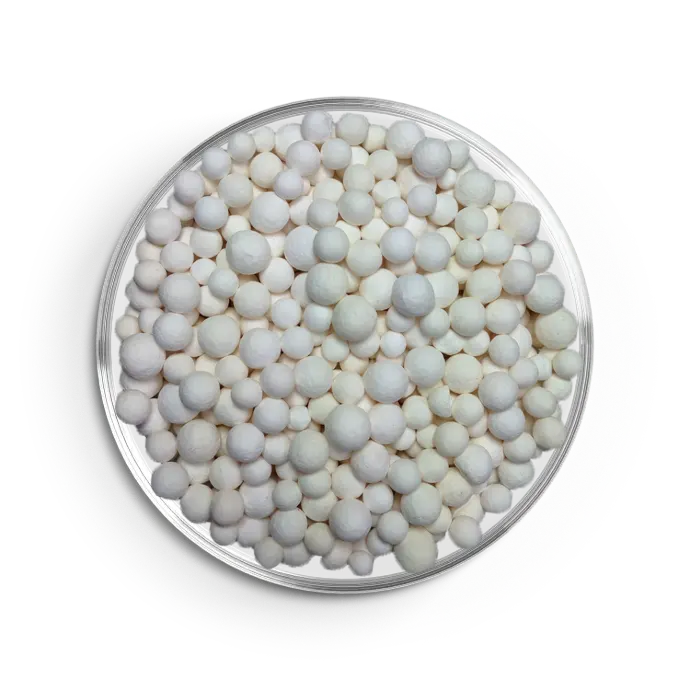
Why is it used?
High surface area
Surface areas of up to 400 m² offer micro-, meso- and macropores with many anchoring sites for metal precursors during impregnation.
Good thermal & mechanical stability
Keeps its structure and surface area up to 700 – 800 °C while resisting sintering better than other oxides.
It`s mechanically robust enough to withstand high pressure drops, vibration, themal cycling and attrition.
Tunable surface chemistry
γ‑Alumina’s surface has both acidic and basic sites. So, it can interact with active phases and stabilize certain oxidation states or dispersions
It can also be modified to tune acidity/basicity for specific reactions.
Compatible with many active phases
Activated alumina works well with: noble metals (Pt, Pd, Rh, Ru), base metals (Ni, Co, Mo, W, Cu) and metal oxides (TiO₂, V₂O₅, CeO₂, etc.)
Special impregnations.
Similar to its application as catalyst carrier, activated alumina can be impregnated with potassium permanganate (KMnO₄) which acts as an oxidizing agent.
The beads provide a porous structure with a high surface area to which the potassium permanganate can adhere. It reacts chemically with many reducing and easily oxidized gases.
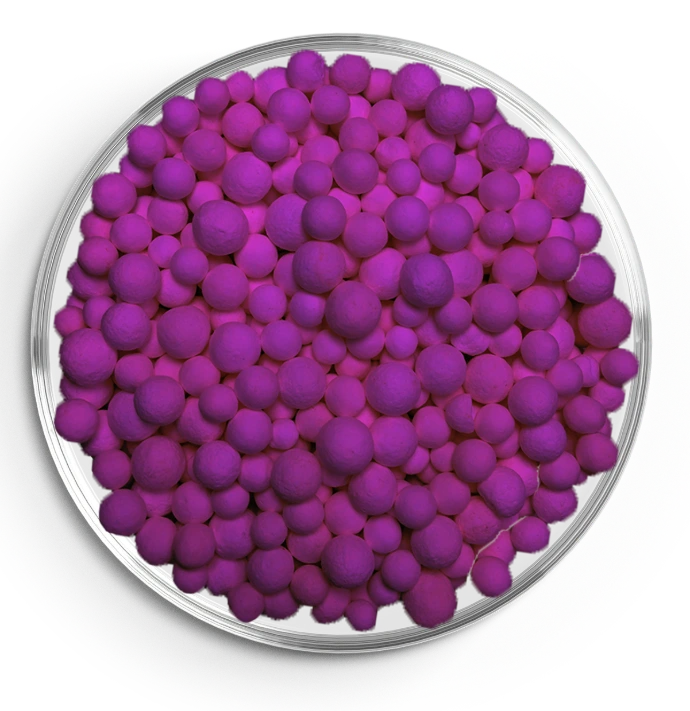
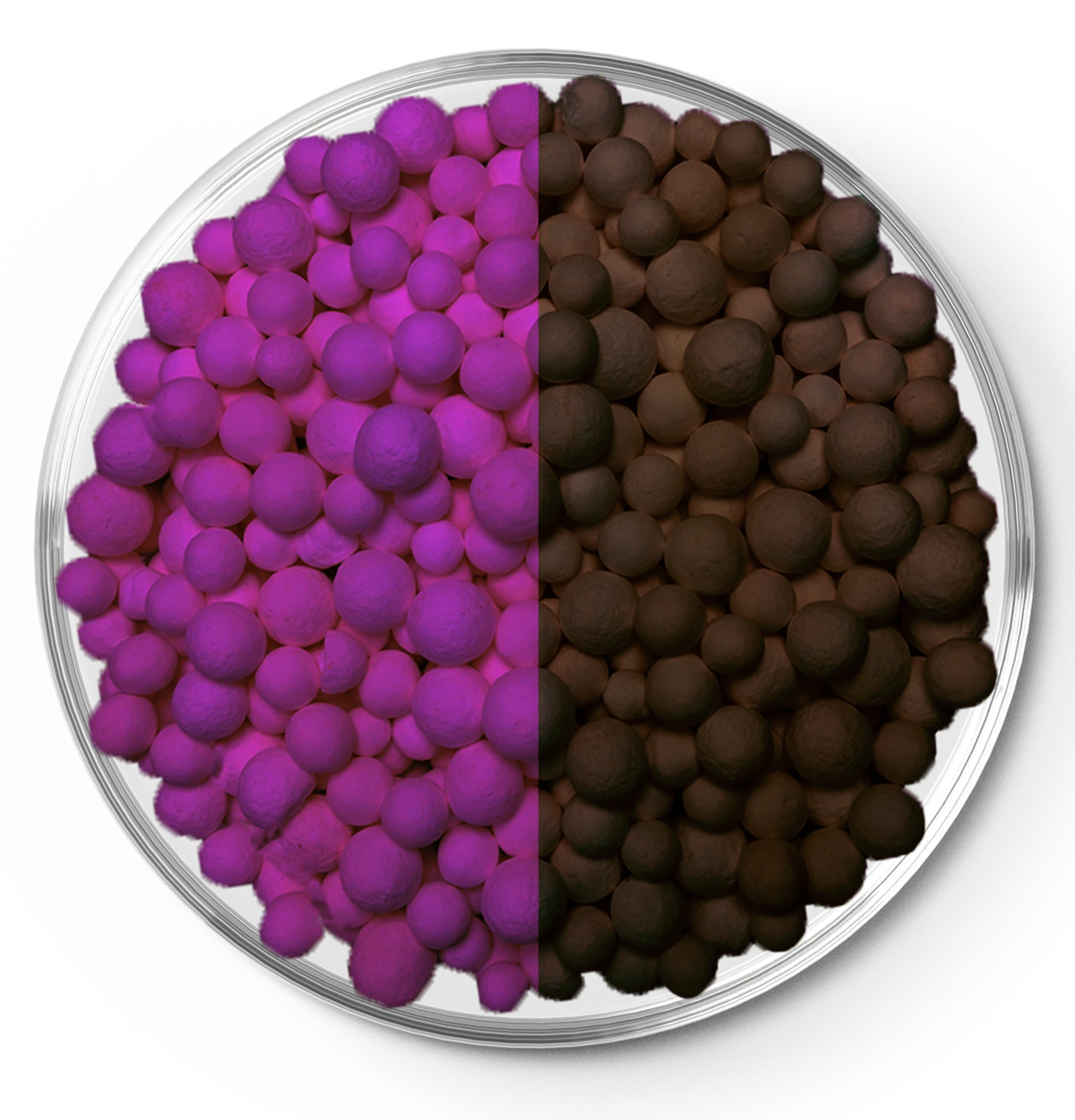
Purple
Fresh granules – ready to oxidize unwanted substances.
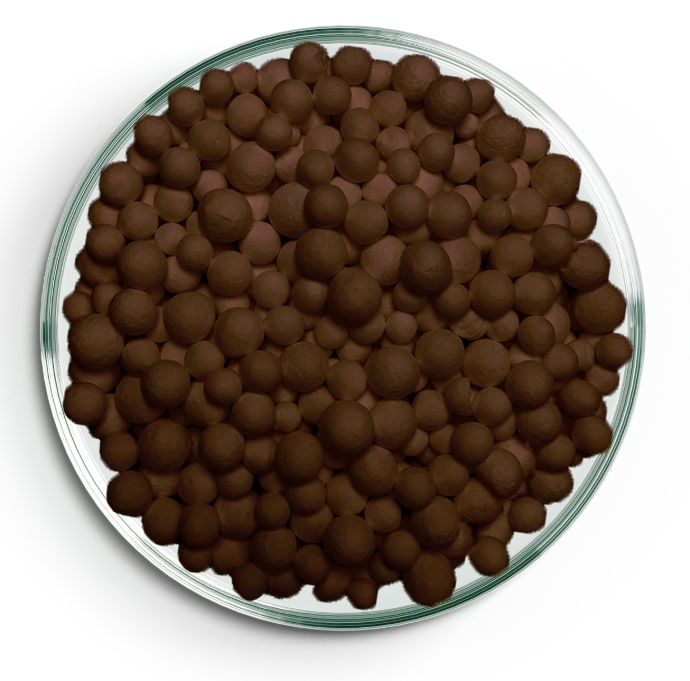
Brown
The potassium permanganate has fully reacted. The granules need to be changed.
Adsorption
Pollutants such as ethylene, formaldehyde, hydrogen sulfide, mercaptans, sulfur dioxide and some VOCs diffuse into the pores of the alumina beads and are adsorbed onto the internal surface.
These substances are relevant, for example, during cold storage of fruits, indoor air purification, or in industrial exhaust systems.
Oxidation by KMnO₄
Once the pollutant gets close enough to the permanganate, a chemical oxidation reaction occurs.
KMnO₄ is reduced, while the pollutant is oxidized to less harmful products.
Formation of solid / harmless products
The reduced manganese ends up mostly as brown MnO₂.
Other products are typically CO₂, H₂O, and some potassium salts.
Not granules, but powder.
GIEBEL Activated Alumina comes in two forms: granuled beads and powder.
Beads |
Powder | |
Form | Beads, usually 3 – 5 mm | Fine powder, ca. 10 µm |
Surface area | Mostly internal | Internal + high external surface area |
Pressure drop | Designed for minimal pressure loss | Not applicable for adsorbent beds |
Applications | Air & gas drying, water purification, removal of pollutants | Dispersions, coatings, formulations, catalyst manufacturing |