Regeneration of activated alumina in cyclic drying processes.
How to regenerate activated alumina in industrial drying processes: desorption principle, timing, and regeneration methods.
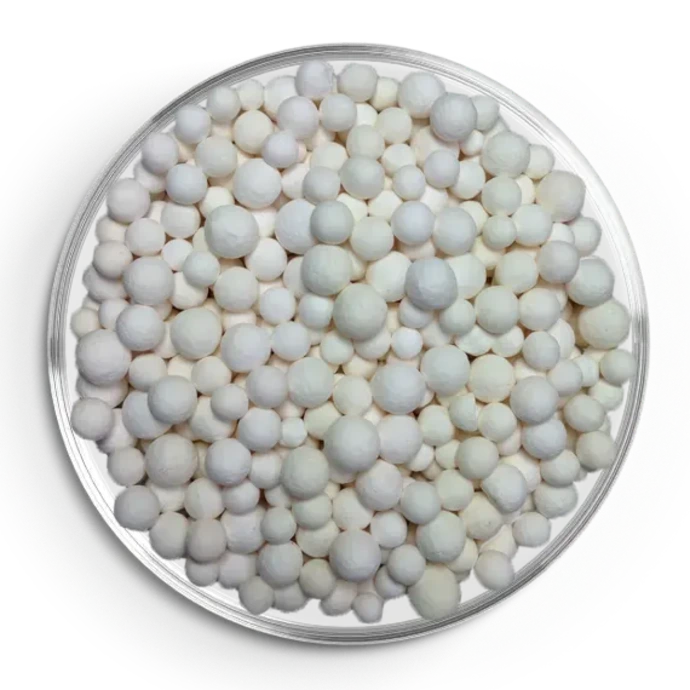
Regeneration reverses the adsorption process.
Activated alumina is a porous adsorbent. Water molecules attach to its extensive internal surface through physical interactions. During regeneration, operating conditions are changed so that the adsorbed water is released and removed from the bed.
From adsorption back to desorption
Water vapour is retained on the pores surface of the activated alumina granules. When the partial water vapour pressure around the granules is reduced or heat is supplied, the balance shifts and water molecules leave the surface.
A flowing purge or regeneration gas carries the released moisture out of the vessel. The bed can then be returned to adsorption once the regeneration and cooling sequence has been completed.

When is regeneration due?
The adsorption cycle must end before the moisture front reaches the outlet and the required product-gas quality is lost. In industrial dryers, the switching point is normally defined by the dryer design, operating cycle and required outlet dew point.
Dew point monitoring
If the outlet dew point no longer reaches the required dew point, it is likely time for regeneration.
The desiccant filling is replaced cyclically based on empirical data and the expected moisture load.
Pressure drop
Similar to dew point measurement, a drop in system pressure can also signal a saturated desiccant bed.
How is activated alumina regenerated?
Thermal regeneration
Heating activated alumina to 200 –220 °C [390 – 430 °F] is enough to break the molecular bonds and loosen most components from the beads pores.
To achieve full regeneration, the entire packed bed must be heated uniformly right through to the core.
Usually, a stream of hot, dry gas is passed through the adsorbent bed. It gives the adsorbed molecules the energy to leave the surface and carries them out of the container.
Pressure reduction
Regeneration does not neccessarily need heat – only less pressure.
On the bead surface, molecules constantly leave and return. What tips the balance is how much vapor is floating around the beads. Lower the total pressure, and the partial water vapor pressure drops with it, so fewer molecules return than leave.
Then, flushed with a little dry gas, the bed dries out
Regeneration applied to industrial standards.
Thermal regeneration and pressure reduction describe two physical processes used to release water molecules from the pores surface. In industrial applications, these principles are utilized to construct cyclic processes.
When is regeneration succesfull?
Just as you can check when your desiccant needs to be regenerated, there are ways to determine whether the regeneration itself was successful or not.
If activated alumina is only partially regenerated, this quickly manifests as shorter cycle intervals. Residual moisture remains in the granules, reducing the maximum capacity during the following adsorption cycle.
After regeneration, a gas stream is passed through the bed which needs to reach the desired dew point.
Electronic humidity sensors can measure rising and sinking humidity levels in closed systems – indicating if the beads are dry enough.
Setpoint comparison
Many systems rely on fixed cycle times with standardized reference values. If the planned service life is not achieved, this indicates ineffective regeneration.
Can activated alumina be reused endlessly?
Activated alumina is designed for repeated adsorption and regeneration. Its mechanical and thermal robustness makes it suitable for demanding industrial drying cycles.
But over time, granules can experience mechanical wear and attrition. Contaminants can also reduce the accessible pore surface and impair adsorption performance.
What can shorten service life?
- Oil and heavy hydrocarbons: may coat the surface and block pores.
- Liquid water: unexpected carryover can disturb normal dryer operation.
- Mechanical stress: can cause abrasion, fines and bed degradation.
- Unsuitable regeneration: excessive temperature or inappropriate moisture/temperature conditions can damage the adsorbent.
Already know which product you need?
Need support choosing the right product or quantity?
FAQ - your questions, answered.
Yes, you can regenerate smaller amounts of activated alumina at home as well.
- Heat your oven to 200 –220 °C [390 – 430 °F]
- Spread the beads out across a baking sheet
- Bake for 2–4 hours
- Let the beads cool down and fill them into an airtight container