Up to 20% more active material per kg with binderless molecular sieves.
Standard beads contain 15–20% binder. Binderless beads don’t. What is left is essentially 100% active zeolite.
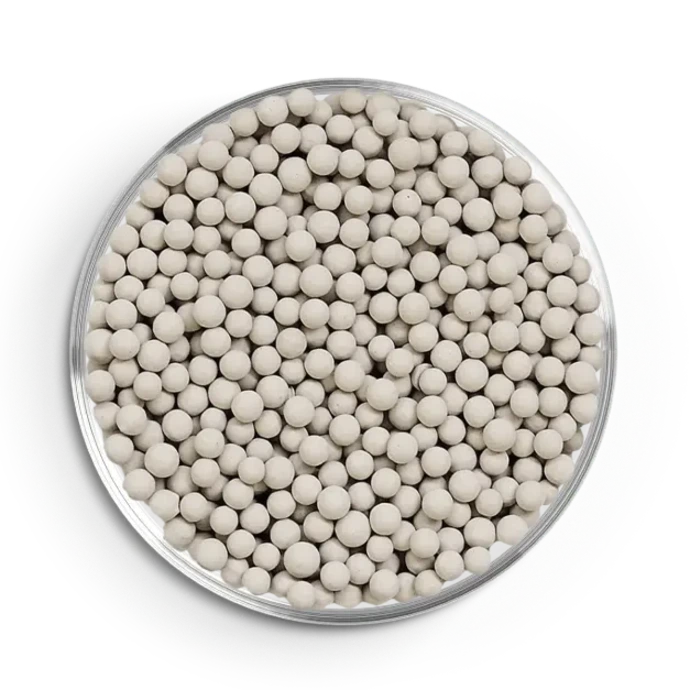
What are binders and why are they there?
Before being sold as a finished industrial product, zeolite crystals usually come as a fine powder. To use it in an adsorber bed, this powder is formed into solid beads. This is exactly where binders come into play – they are used as glue to hold the structure together and give the beads strength.
But there is one catch: The most common type of binder is clay. And clay does not adsorb anything, it only holds things together.
Therefore, a regular zeolite molecular sieve consists of only 80 – 85 % of active zeolite with the binder material being an inactive component.
How binderless beads are made.
To improve adsorption properties, specialised production methods are used to form solid beads without binders in the final product.
1
Form
The beads are first formed with a clay binder, like standard beads.
2
Convert
The binder is converted into zeolite itself. Crystals grow into each other on the inside to hold the structure together.
3
Activate
Dry and activate the finished bead.