Suitable desiccants for your adsorption dryer.
Low dew points down to -70 °C
Efficient regeneration
Consistent processes
Adsorption dryers are used wherever standard refrigeration dryers are no longer sufficient. For instance, when a very high degree of dryness is required (dew points below −20 °C) or when temperatures are too low to allow for the separation of condensate.
How does an adsorption dryer work?
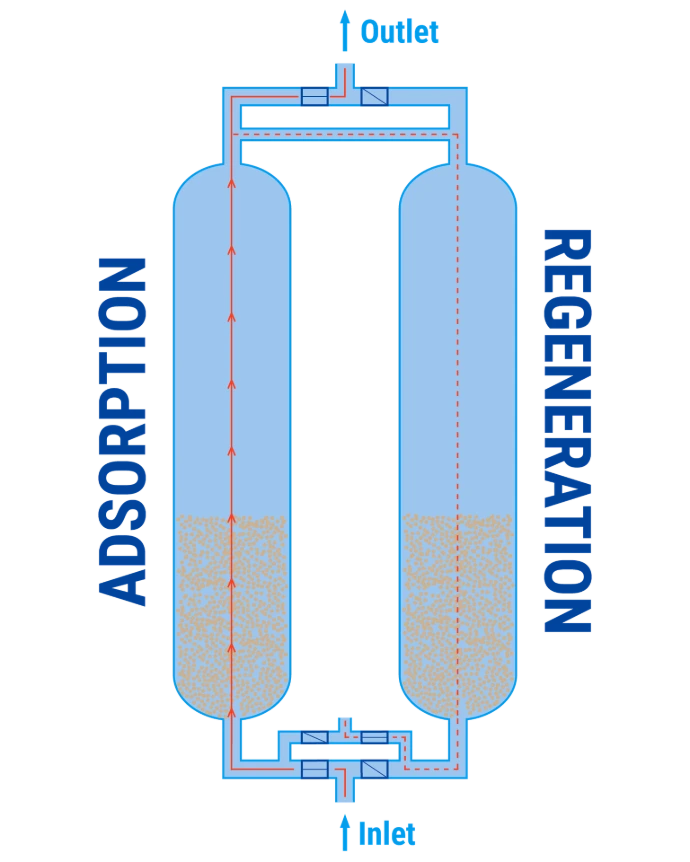
An adsorption dryer is a system designed to dry air or gases. It consists of two pressure vessels filled with a desiccant which operate in a continuous, alternating cycle between adsorption and regeneration.
Adsorption
One vessel is used for adsorption—that is, for drying. The gas stream is passed through the desiccant granules which capture moisture much like a magnet. The result is a dried gas stream at the outlet.
During the adsorption phase, the desiccant absorbs moisture until it reaches its maximum capacity (i.e., it becomes saturated).
Regeneration
Simultaneously, the moisture-saturated granules in the second vessel undergo regeneration. To achieve this, a small portion of the already dried gas stream from the first vessel is diverted into the second vessel.
Combined with heating or a reduction in pressure within the vessel, the captured moisture is released from the desiccant and carried away by the gas stream. This restores the granules making them ready for reuse.
Alternating Operation
Adsorption and regeneration always take place at the same time. Once the desiccant in one vessel becomes saturated with moisture, the gas flow is redirected via valves and that vessel switches to the regeneration phase. Meanwhile, the other vessel, now containing freshly regenerated material, begins the adsorption process.
This creates a cyclical operation that allows the system to run continuously.
Cold- and heat-regenerating.
In the case of adsorption dryers, a distinction is made between cold- and heat-regenerating systems.
These terms refer to the method used to regenerate the saturated desiccant.
Cold-regenerating
Pressure-Swing-Adsorption (PSA)
The pressure in the regeneration vessel is reduced, allowing water molecules to detach from the desiccant.
A portion of the dried gas stream is diverted and directed into the regeneration vessel. There, it takes up the released moisture and carries it away.
Heat-regenerating
Temperature-Swing-Adsorption (TSA)
The desiccant granules are heated in the regeneration vessel, causing the bound moisture to be released from the beads.
The moisture is removed from the vessel, leaving behind regenerated granules.
Best of both worlds
TSA and PSA in one
Some systems combine both temperature swing and pressure swing adsorption to compensate for the respective disadvantages of the individual methods.
The goal of this combination is to achieve maximum drying and cleaning performance with minimal energy consumption and the longest possible service life for all components.
Which desiccants are used, and when?
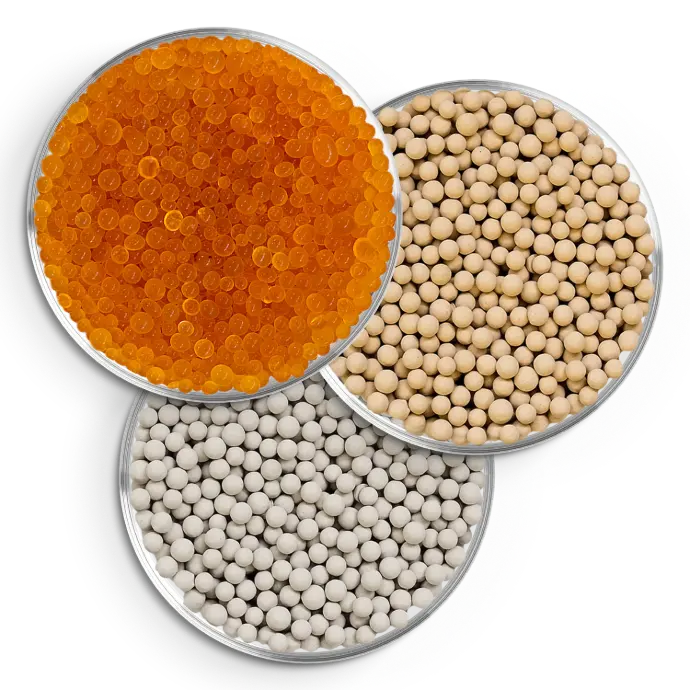
The choice of desiccant determines the dew points that can be achieved under specific conditions:
Silica Gel | Molecular Sieve | Activated Alumina | |
|---|---|---|---|
Achievable dew point | -20 to -40 °C | -70 to -100 °C | -40 to -70 °C |
Regeneration temperature | 140 °C | 300 °C | 200 to 220 °C |
Water-resistant | (Yes)* | No | Yes |
Suitable product | Poresphere® Al-H & AL-W | Cagesphere® 4A & 13X | Poresphere® Aktiv-AL |
Regeneration type | TSA | PSA | TSA & PSA |
*only specialized types such as GIEBEL Poresphere® AL-W
Are you having issues with condensation?
High levels of moisture can lead to the formation of condensation. In such cases, it is advisable to use a protective layer ahead of the primary desiccant.
Why? Most desiccant granules are designed to adsorb water vapor, not to come into contact with liquid water. If they do, a strong reaction occurs causing the beads to break apart.
The consequences include increased abrasion, the formation of dust and restricted airflow.
Water-resistant silica gel such as PORESPHERE® AL-W prevents this breakdown of the granules by acting as a protective barrier.
Are you looking for a new desiccant supplier?
We have already supplied desiccants for the following adsorption dryers:
Atlas Copco
Donaldson
Ingersoll Rand
KAESER
Motan
Motan sDry equivalent