Desiccants for industrial applications: protection against moisture, corrosion, and long-term damage.
How do desiccants work? What is adsorption? And what product options are available?
What are desiccants used for?
Air/gas stream contains moisture
Ambient air contains water vapor – even though we cannot see it. This invisible moisture can cause damage.
Desiccants
Desiccants attract water molecules – either physically or chemically – and bind them, removing them from the surrounding air.
Air becomes drier.
The moisture remains bound to or within the desiccant, allowing the humidity of the surrounding air to be successfully reduced.
Dry outcome
Effective protection against corrosion, mold, or other moisture-related damage and reliable drying in industrial processes.
Desiccants are used to remove moisture from air or gases, thereby protecting products, materials, and technical systems from damage.
They are employed in any scenario where even small amounts of water could lead to corrosion, condensation, a loss of quality, or functional malfunctions. The selection process depends not only on maximum water absorption capacity but, more importantly, on specific operational conditions—such as temperature, relative humidity, regenerability and service life.
Here’s how it works.
For industrial dehumidification, the distinction between adsorption and absorption is fundamental, as it determines the long-term viability of the desiccant and its chemical resistance throughout the drying process.
= Physical bonding
The majority of industrial drying processes are based on adsorption. In this process, water molecules attach themselves to the internal surface of a highly porous solid via physical interaction.
Granular form remains stable
No liquefaction
Regenerable / reusable
= Chemical reaction
During absorption, water penetrates the interior of a substance and chemically bonds with it (e.g., in the case of hygroscopic salts).
The material liquefies
Simple, single-use applications or specific chemical processes
How silica gel captures water.
Silica gel is full of tiny pores. Formed into small beads, 1g of granules offers a surface area of almost three tennis courts.
The pore walls carry silanol groups (Si-OH), which work like small hooks: water molecules from the air dock onto them through hydrogen bonds. At higher humidity, vapor can also condense inside the small pores (capillary condensation).
This way, silica gel takes up over 35% of its own weight in water. That is about 350g per kilogram.
The water molecules only stick to the surface, with no chemical reaction, so the beads keep their shape.

Adsorption principle of molecular sieves.
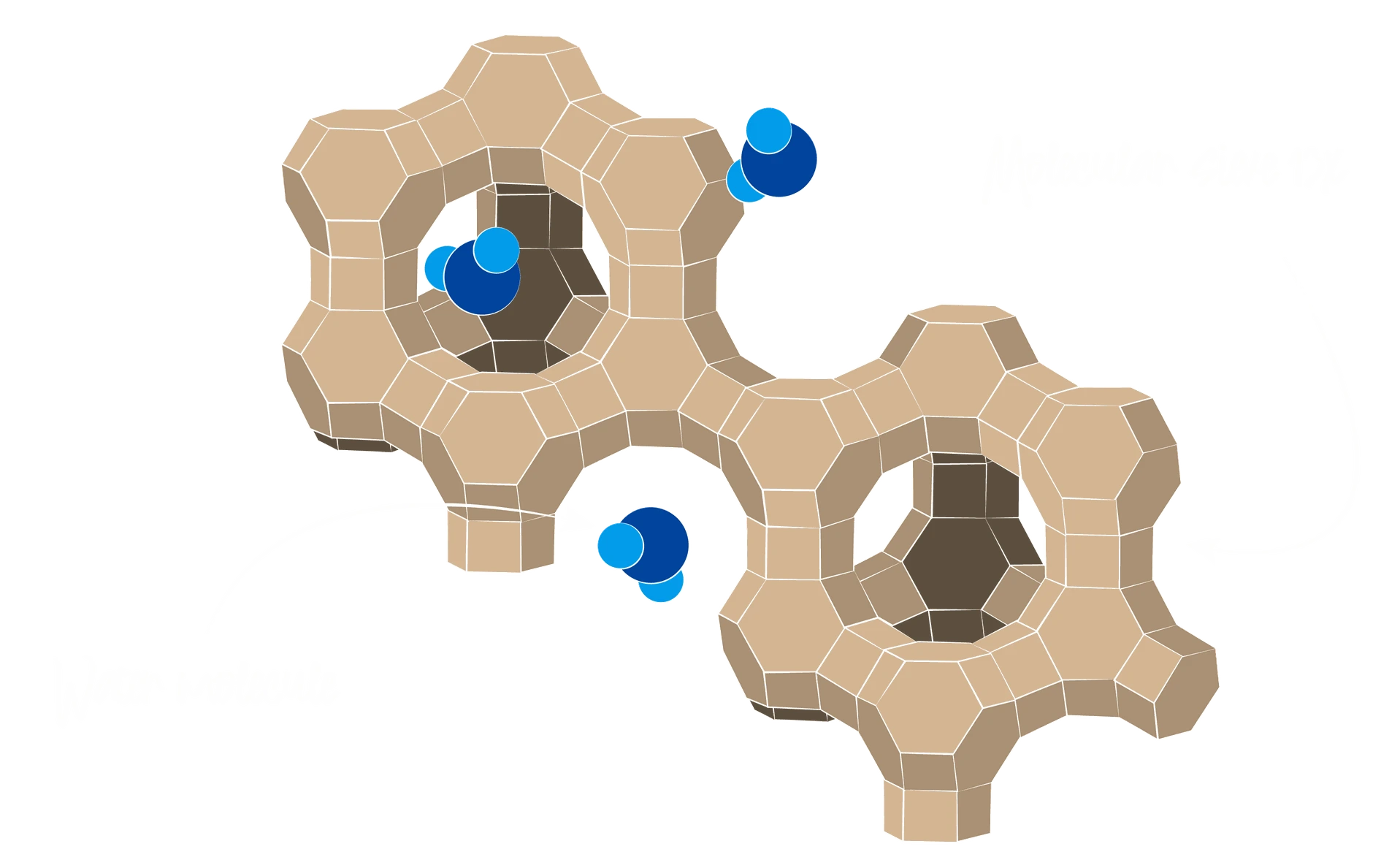
A molecular sieve consists of zeolite, a crystal permeated by tiny pores. Unlike other desiccants, these pores are all exactly the same size, much like the holes in a sieve.
The unique feature: only molecules small enough can pass through these pores. Water molecules, for instance, are tiny and slip inside, while larger molecules remain on the outside. In this way, a molecular sieve can absorb water equivalent to about 20 – 25% of its own weight – meaning 1 kg of the desiccant can hold more than 200 g of water.
Once inside, the water is held in place by physical forces, without the beads changing their shape. Even in very dry air-conditions a molecular sieve continues to reliably retain water where other desiccants would cease to be effective.
Adsorption principle of activated alumina.
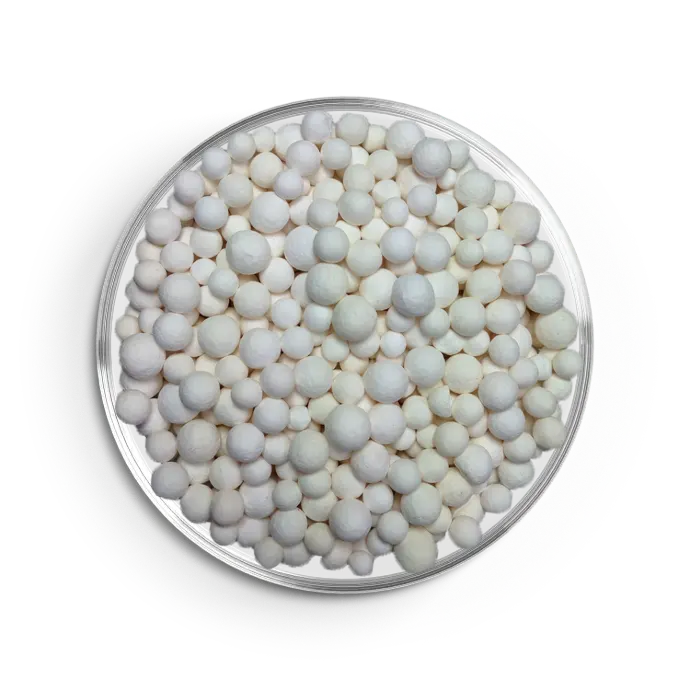
Activated alumina is a highly robust, porous material. Its interior is permeated by countless tiny channels, somewhat like a sponge, though much firmer.
It can absorb water equivalent to about 20% to 30% of its own weight; for one kilogram of the desiccant, this amounts to approximately 200 to 300 grams.
Water molecules are held to the surface by physical forces, and the spheres do not change their shape in the process. Because activated alumina is so hard, the spheres remain intact even when they come into contact with liquid water. Some other types of desiccants would simpy shatter in this case.

Where there is adsorption, there is also desorption.
Adsorbent desiccants can be reused after they have become saturated with moisture.
Desorption is the opposite of adsorption: water molecules that have attached themselves to a desiccant detach from its surface. This is possible because they are held there only like tiny magnets, rather than being firmly bonded. With the addition of some energy, for instance, in the form of heat, the molecules begin to move again and are driven out of the pores.
Once this occurs, the desiccant is dry again and can once more absorb water. This physical process is called desorption, while the act of restoring the desiccant to a functional state is known as regeneration.
How to choose the right desiccant.
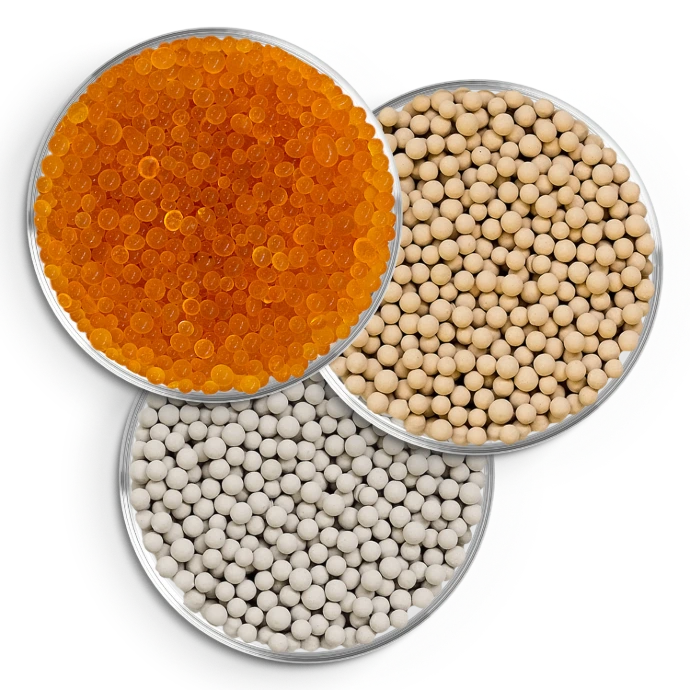
All three desiccants adsorb moisture. Nevertheless, each has certain environmental conditions under which it can best demonstrate its individual strengths.
Desiccant | Silica Gel | Molecular Sieves | Activated Alumina |
Use case | Air drying | Deep drying (ppm-range), selectively adsorbing H₂O in multi-component streams | Drying in harsh industrial processes |
Humidity spectrum | 20 – 90 % RH | <20 % RH | 20 – 100 % RH |
Temperature spectrum | up to 100 °C | up to 250 °C | up to 200 °C |
Pressure resistance | Moderate | Moderate | High |
A comparison of GIEBEL adsorptive desiccants.
PORESPHERE® Silica Gel | CAGESPHERE® Molecular Sieves | PORESPHERE® Activated Alumina | |
|---|---|---|---|
|
|
| |
Color indicator | Yes | No | No |
Maximum H₂O-capacity | 37 – 90 % | 25 % | 30 % |
Specific surface area | 600 – 800 m²/g | 500 – 1000 m²/g | 330 m²/g |
Pore volume | 0,35 – 1,00 ml/g | 0,35 – 0,70 ml/g | 0,50 ml/g |
Regeneration | 120 – 140 °C | 300 °C | 200 – 220 °C |