Molecular sieves for ethanol dehydration.
After distillation, ethanol has a purity of ~ 96% by volume. For certain applications, the residual water content must be removed further.
Anhydrous ethanol
99% purity
Suitable for PSA (Pressure Swing Adsorption).
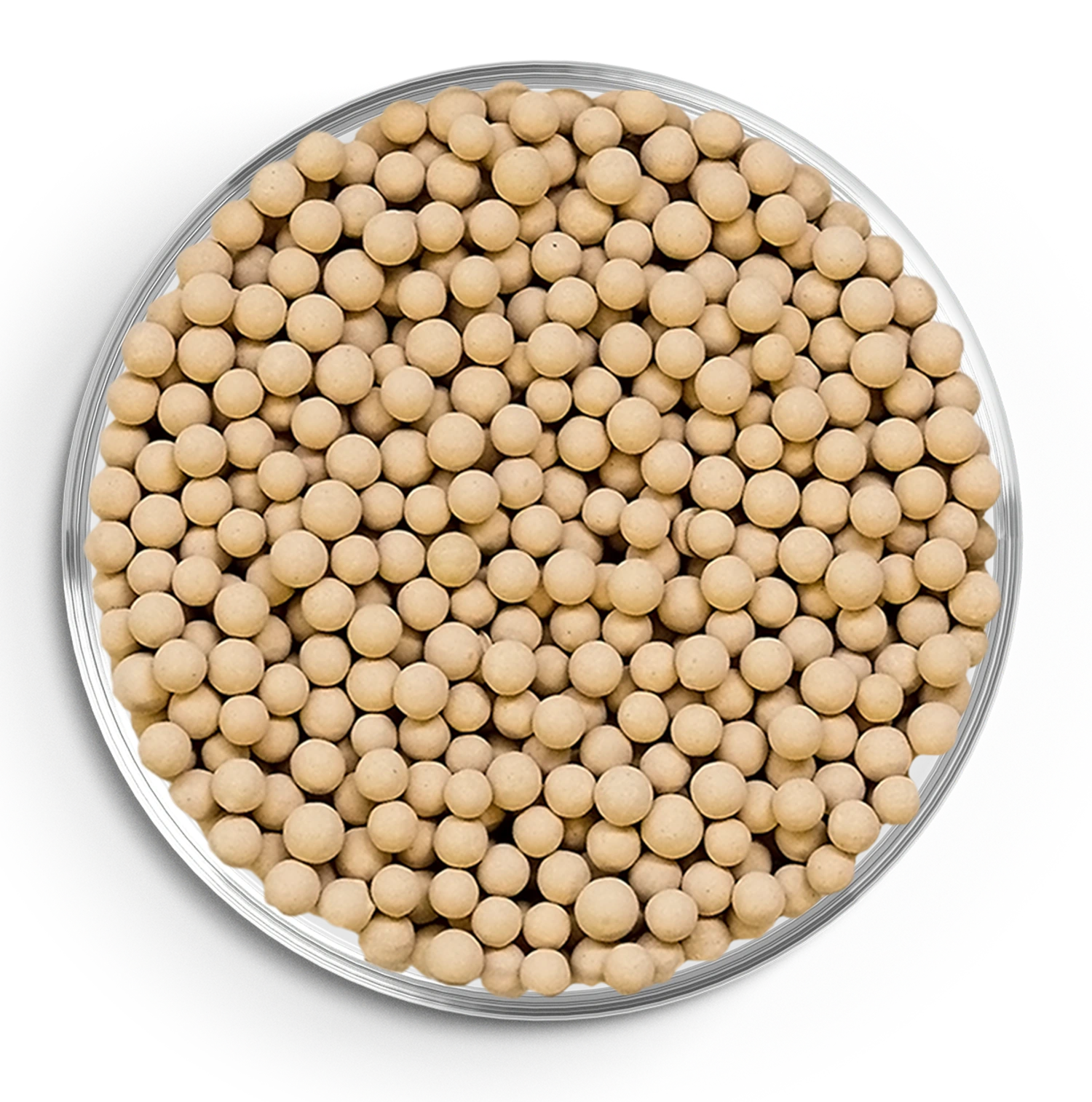
What happens when distillation is not enough?
At an ethanol concentration of 96.5% by volume, ethanol and water form an azeotrope. This means that both substances in this mixture have the same boiling point, making further separation via distillation impossible.
When a purity level of at least 99% ethanol by volume is required, an additional process step comes into play:
Adsorption using molecular sieves
This is how the adsorption of residual water works.
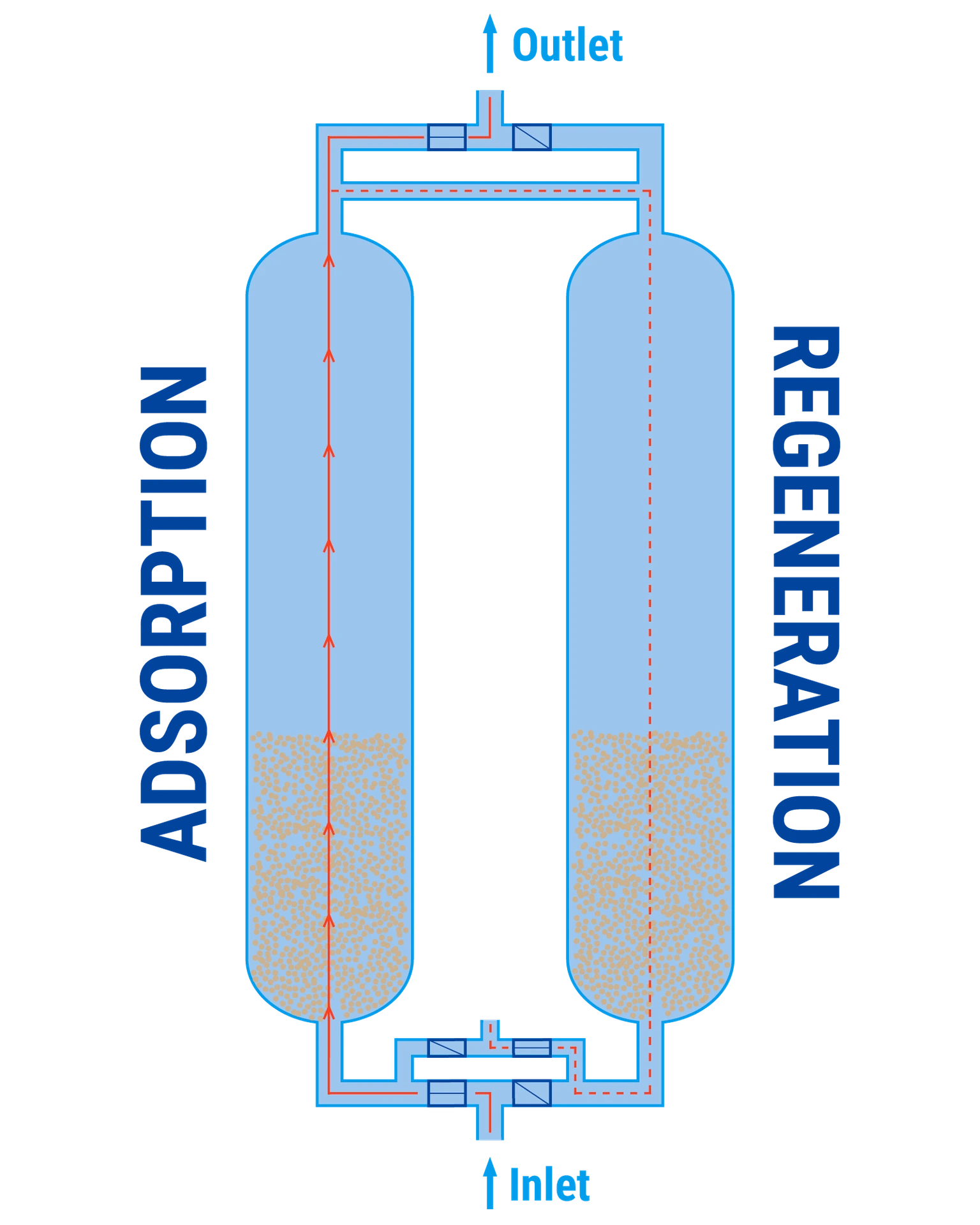
Large industrial plants use Pressure Swing Adsorption (PSA). The system consists of two adsorption vessels filled with molecular sieve material, which operate in an alternating cycle.
Adsorption
Gaseous, moist ethanol flows through the active vessel. The molecular sieve granules trap water molecules within their pores (adsorption) until the desired level of purity is achieved.
A small portion of the high-purity ethanol vapor (10–25%) is diverted to serve as a dry purge gas for regeneration.
Regeneration
The previously active and now saturated with moisture vessel is depressurized, causing the bound water molecules to be released from the molecular sieve (desorption). The diverted purge gas flows through the vessel and carries away the released moisture.
The granules are thus regenerated and ready to be used for adsorption again in the next cycle.
The right molecular sieve.
With few exceptions, molecular sieves are synthetic zeolites with a surface consisting of numerous pores. These pores have precisely defined opening sizes.
As a result, only molecules smaller than the pore openings can enter the interior of the pores. All other, larger molecules pass by the molecular sieve unaffected.
A material is required that can bind water without affecting ethanol.
Ethanol molecular diameter: 4,3 Å
Water molecular diameter: 2,6 Å
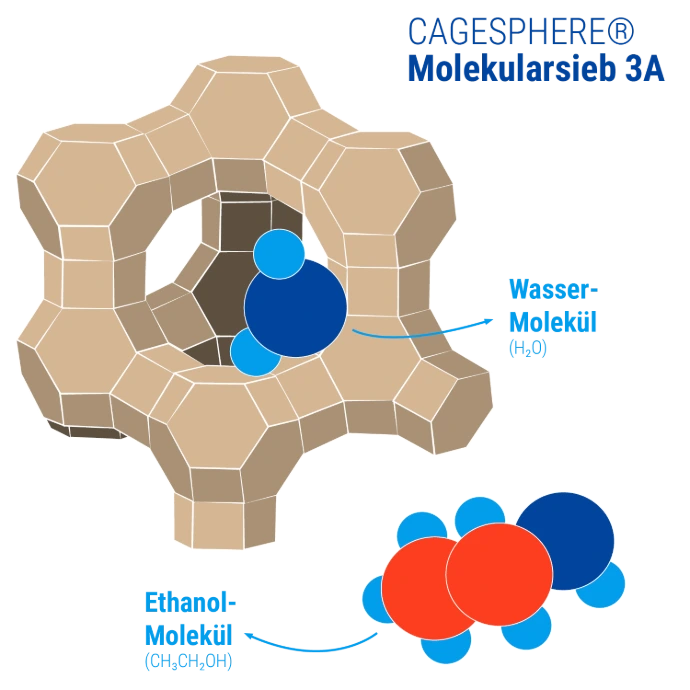
Das richtige Molekularsieb.
Bis auf wenige Ausnahmen sind Molekularsiebe synthetische Zeolithe, deren Oberfläche aus zahlreichen Poren besteht. Diese Poren besitzen exakt groß definierte Porenöffnungen.
Damit können nur Moleküle in das Innere der Poren gelangen, die kleiner als die Öffnung sind. Alle anderen, größeren Moleküle strömen unberührt am Molekularsieb vorbei.
Es wird ein Material benötigt, das Wasser binden kann, aber nicht das Ethanol beeinflusst.
Ethanol-Moleküldurchmesser: 4,3 Å
Wasser-Moleküldurchmesser: 2,6 Å
Why types 4A, 5A, and 13X are unsuitable:
For variants 5A and 13X, the decision is reached quickly. With pore openings of 5 Å and 10 Å, they are already so large that they would adsorb not only the unwanted water but also the ethanol itself.
With type 4A zeolites, the devil is truly in the details.
In theory and under optimal conditions the 4A pore openings are precisely defined as 4 Å. In practice, however, a distinction is made between the actual pore size and the effective pore size.
The actual pore size accounts for the fact that zeolites are influenced by various factors during operation, leading to deviations from theoretical values. Consequently, the 4A molecular sieve has an actual pore opening of 4.2 Å.
While this is still too small for ethanol (4.3 Å), the difference is only marginal. Under certain circumstances, ethanol may still be adsorbed which poses a critical factor for this specific application.
Therefore, the 3A molecular sieve offers the optimal solution for the drying of ethanol.
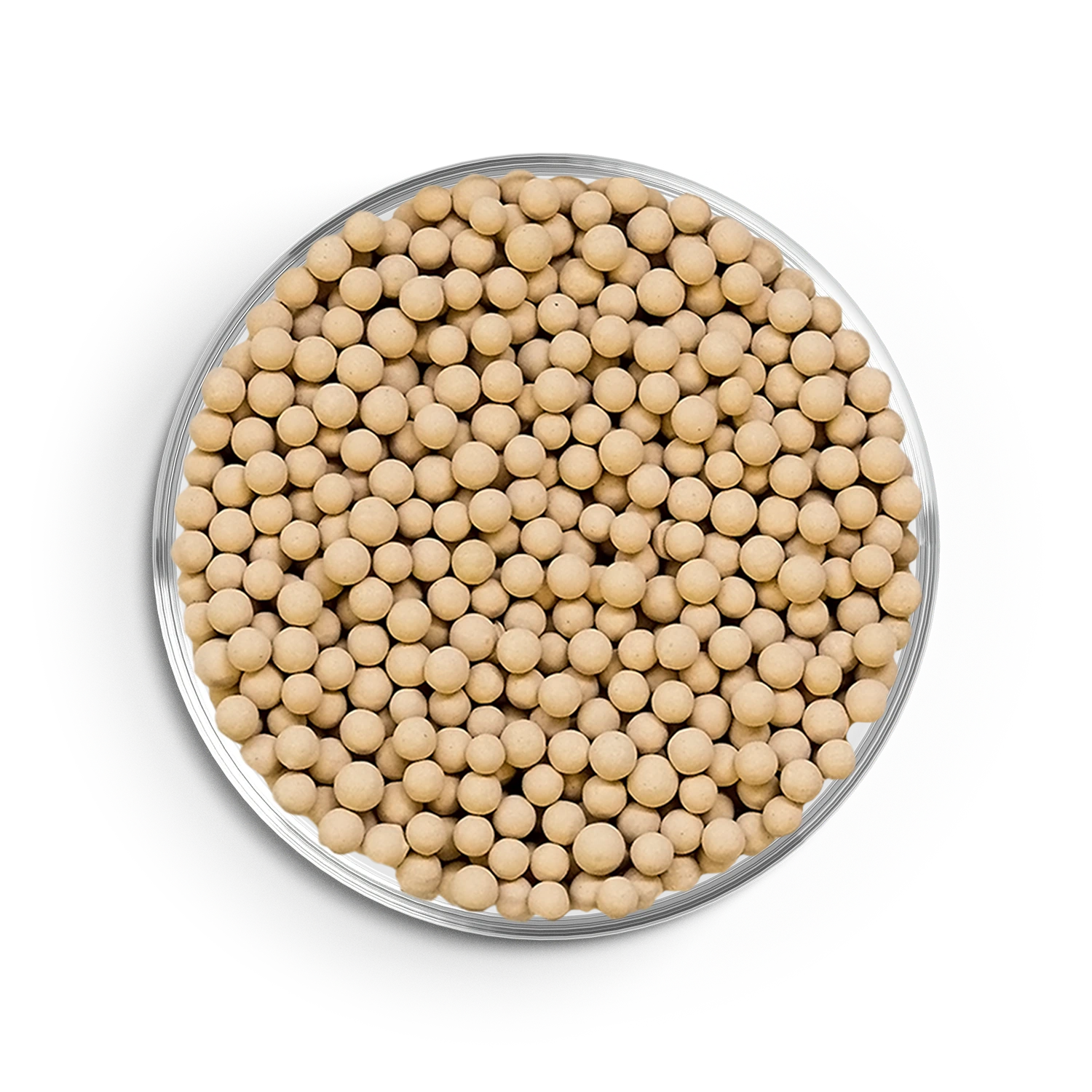
CAGESPHERE® 3A
Molecular Sieve Type 3A
Adsorbs virtually no other molecules
- Actual pore size: 3 Å / 0,3 nm
- Effective pore size: 3,8 Å / 0,38 nm
- Bulk density 0,67kg/l
- Crushing strength >70N
- Attrition rate <0,25%
- Water adsorption capacity >210ml/kg
- Regeneration temperature 300°C