Adsorbents for industry and laboratory: More than just moisture absorption.
How do adsorbents work? What is adsorption? And what product options are available?

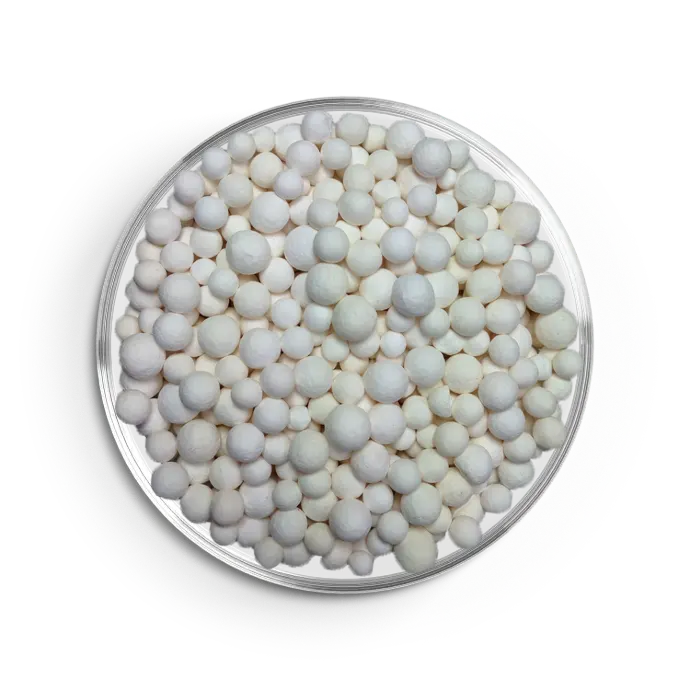

What is an adsorbent?
Adsorbent = Magnet for molecules
Think of an adsorbent as a highly specialized "molecular magnet." Thanks to its extremely large internal surface area, it selectively attracts foreign substances and physically traps them within its pores. While many people first associate adsorbents with moisture control, their industrial applications are far broader: they are used to separate mixtures of substances, eliminate odors, or filter oil vapors out of industrial processes.
How it works: Adsorption.
Contaminated medium
Gases, air, or liquids contain unwanted substances that are to be removed.
Adsorbent
A highly porous solid (e.g., zeolite, activated carbon, or silica gel) serves as an adsorption medium and is integrated into the process.
Adsorption
Target molecules are bound to the surface of the adsorbent by molecular attractive forces.
Purified result
Interfering substances have been filtered out and removed. The input medium is purified.
Adsorbent vs. desiccant.
Which is which?
An adsorbent can be a desiccant, but not every desiccant is automatically an adsorbent. Don’t let that confuse you! It’s actually not that complicated. One term refers to a functional principle, while the other describes an application:
Adsorbent
Describes a function – namely, the adsorption of molecules onto a porous surface.
Adsorbents are specialists in surface binding. They bind not only water but also a wide variety of other substances, such as H₂O, CO₂, alcohols, aromatics, etc.
Desiccant
Describes only one application – namely, absorbing moisture and drying.
Desiccants are used exclusively to combat unwanted moisture. This can occur physically through the process of adsorption, or via other mechanisms.
A desiccant can be an adsorbent if it adsorbs water molecules onto its surface.
However, there are also desiccants that are not adsorbents; instead, they react chemically with H₂O molecules like for example, calcium chloride.
Adsorption principle of silica gel.
Silica gel is a highly porous substance – meaning that countless pores are distributed across its entire surface.
Formed into small spheres, it creates a granulate where just 1g offers a surface area nearly the size of three tennis courts. It is primarily used to remove unwanted, high levels of humidity from the air.
Water molecules are actively held on the surface through physical interactions, all without the spheres changing their shape.

Adsorption principle of molecular sieves.
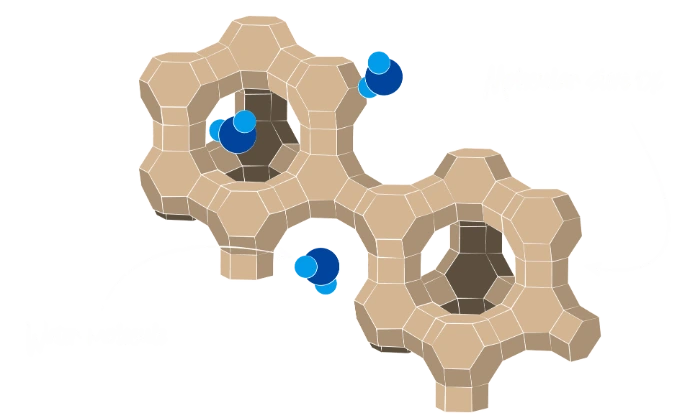
A molecular sieve consists of zeolite, a crystal permeated by tiny pores. Unlike those in silica gel, these pores are all exactly the same size, much like the holes in a sieve.
The unique feature: only molecules small enough can pass through the pores. Water molecules, for instance, are tiny and slip inside, while larger molecules remain on the outside.
Molecular sieves come in various types with different pore sizes, allowing for the targeted adsorption of specific substances.
Once inside, the molecules are held in place by physical forces, all while the beads themselves retain their original shape. Molecules with a polar charge are particularly likely to be captured in this way.
Adsorption principle of activated alumina.
Activated alumina is a highly robust, porous material. Its interior is permeated by countless tiny channels and pores, somewhat like a sponge, though much firmer.
On the internal surface of these pores, there are so-called hydroxyl groups (-OH). These can form bonds with specific ions and polar molecules, effectively "holding" them in place.
In this way, the material uses physical forces to bind various substances to its surface, all while the spheres themselves retain their original shape.
Examples of such substances include water molecules, fluoride ions, and hydrogen sulfide.

How to choose the right adsorbent.
All three have one thing in common: they can perform drying. Beyond that, the choice of the right material depends on the substances to be adsorbed and the process conditions.
Silica Gel | Molecular Sieves | Activated Alumina | |
|---|---|---|---|
Adsorption spectrum | Mainly water, special variants for carbon dioxide | Broad and selective spectrum of molecules (depending on the type) | Water, fluoride, hydrogen fluoride and hydrogen chloride, hydrogen sulfide, sulfur dioxide, etc. |
Affinity | Polar molecules | Molecule size, polar molecules | Polar molecules and ions |
Pressure resistance | Moderate | Moderate | High |
Temperature spectrum | up to 100 °C | up to 250 °C | up to 150 °C |
Humidity spectrum | 20 – 90 % RH | <20 % RH | 20 – 100 % RH |
GIEBEL adsorbents compared.
PORESPHERE®
| CAGESPHERE®
| PORESPHERE®
| |
|---|---|---|---|
Applications | Breather dryers, Industrial drying | Industrial drying, gas drying & purification, air separation units etc. | Industrial drying, water purification, removal of acidic gases & pollutants |
Specific surface area | 600 – 800 m²/g | 500 – 1000 m²/g | 330 m²/g |
Pore volume | 0,35 – 1,00 ml/g | 0,35 – 0,70 ml/g | 0,50 ml/g |
Regeneration | 120 – 140 °C | 300 °C | 200 – 220 °C |

