Silica gel. How the desiccant works.
Silica gel is used wherever moisture causes costly damage. Yet there is more magic behind those little beads than one might think at first glance...
 |
 |
 |
|
|
|



What is silica gel?
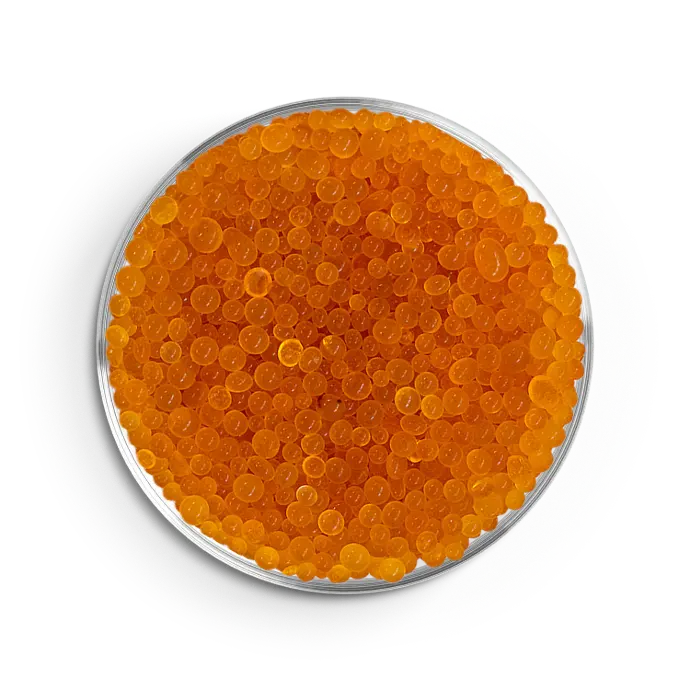
Silica gel—also known as silicic acid—is a chemical compound made of silicon and oxygen (silicon dioxide, SiO₂) that is typically formed into small beads. Its primary function is to adsorb moisture from the immediate surroundings.
There is a great deal more to these unassuming beads than meets the eye when viewed under a microscope. Inside, they contain countless pores that collectively create an enormous internal surface area – equivalent to nearly 3 tennis courts per gram of silica gel. Large quantities of water molecules can accumulate within these pores.
Air contains moisture
Ambient air contains water vapor – even though we cannot see it. This invisible moisture can cause damage.
Silica Gel
Desiccant beads have an enormously large, polar surface area. They physically attract and bind water molecules – entirely without the use of chemicals.
Air gets drier
The bound moisture remains trapped on the surface of the granules, and the humidity of the surrounding air can be successfully reduced.
Check via color indicator
Many types of silica gel indicate when they are saturated and can no longer absorb water by changing color. Time to replace the desiccant beads!
How can silica gel adsorb moisture?
Water molecules in the air are smaller than the pore openings on the surface of the silica gel. As a result, they can easily penetrate them and are held fast at the surface by physical forces.
Adsorption
= physical interaction
Water molecules accumulate in the pores on its surface, where they are held in place by physical interactions (physisorption).
Polar water molecules form a temporary bond with the polar surface of the silica gel due to electrostatic attraction.

Absorption
= typically a chemical reaction (e.g., with calcium chloride)
Water molecules penetrate deep into the material, and the moisture is absorbed into its volume.
This process is often irreversible, and the desiccant cannot be reused.
Typical applications for silica gel.
As an effective desiccant, it reliably protects sensitive equipment and products against moisture-related damage that would otherwise lead to rust, mold, short circuits, or a loss of quality.
Protection of Transformer Insulating Oil
Temperature fluctuations during operation create positive and negative pressure within the insulating oil tank, which is equalized by a breather valve on the transformer.
This "breathing" process introduces atmospheric moisture into the system along with the incoming air. Filter housings filled with silica gel dry the incoming air, preventing costly damage caused by corrosion.
Filament Drying in 3D Printing
Plastic filament is hygroscopic and absorbs moisture from the ambient air during storage. When the filament is subsequently heated during printing, the water rapidly evaporates and forms bubbles. This results in stringing and uneven extrusion.
Silica gel is used—particularly with materials such as Nylon, PETG, and TPU – to keep the filament dry during storage.
Adsorption Dryers in Compressed Air Treatment
Compressed air is subject to strict industrial requirements. One of these is a specific level of dryness to protect equipment from residual moisture in the airflow.
For this reason, adsorption dryers – which are filled with materials such as silica gel – are used. This material effectively dries the air flowing through the system.
Advantages over other desiccants.
Silica gel offers properties that make it attractive for both large-scale industrial clients and private users. It is characterized by a comparatively high absorption capacity and can bind up to 35% of its own weight in water – equivalent to 350g of water per kilogram of granules. It can also be regenerated at low temperatures ranging from 120°C to 140°C.
Unlike calcium chloride, which partially liquefies as it absorbs moisture, silica gel retains its structural integrity throughout the process. Furthermore, it rarely reacts chemically with other substances and is both odorless and non-toxic. This makes it suitable for use in sensitive sectors such as the pharmaceutical and food industries, where even the slightest contamination is unacceptable.

Property | Clay (Bentonite) | Calcium chloride | Silica gel | Molecular sieve | Activated alumina |
|---|---|---|---|---|---|
Application | Dehumidification | Dehumidification | Dehumidification | Selective adsorption, deep drying | Selective adsorption, robust properties |
Moisture absorption | Moderate (~20%) | Very high (~200%) | High (~35%) | Moderate (~25%) | Moderate (~25%) |
Form during adsorption | Swells | Liquefies | Unchanged | Unchanged | Unchanged |
Reaction with other substances | Forms chemical compounds | Forms chemical compounds | Chemically inert | Chemically inert | Chemically inert |
Reusability | Regenerable | No | Regenerable | Regenerable | Regenerable |
Choosing the right silica gel for your requirements.
Silica gels vary in terms of pore size, particle size, and additives – such as color indicators – as well as material composition in the case of specialty variants. Specific process environments are the deciding factor in determining which silica gel is best suited for the job.
To quickly determine how much moisture the desiccant beads have absorbed, specific color indicators can be added to the material. These gradually change color as the moisture content rises, signaling when the silica gel can no longer absorb moisture and needs to be replaced.
Common variants include orange/green and orange/colorless combinations. Other color combinations, such as blue/pink or blue/white (blue gel), are not recommended, as they contain harmful substances. 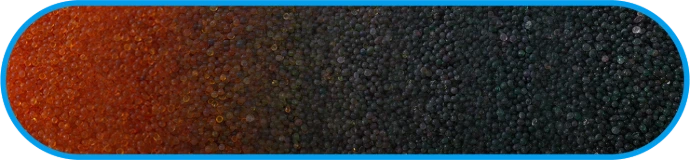
Discover more
Silica gels can be broadly categorized into narrow-pore and wide-pore variants:
Narrow-pore silica gel (2–3 nm) binds water molecules within its pores even at low humidity levels (starting at 20% RH), but it becomes saturated quickly in environments with very high humidity.
Wide-pore silica gel (6–12 nm) is most effective at higher humidity levels (above 60% RH). Its large pores can rapidly absorb significant amounts of water, but it struggles to function effectively when humidity is already low.
Standard silica gels typically consist of 99% pure silicon dioxide (SiO₂). To enhance their adsorption properties, a certain amount of aluminum oxide (Al₂O₃) can be incorporated into the structure of the desiccant beads.
The aluminum oxide increases the beads' mechanical stability (compressive strength), heat resistance, and drying performance at low relative humidity.
A particularly high alumina content (>10%) renders the beads resistant to liquid water, ensuring they do not lose their shape upon contact.
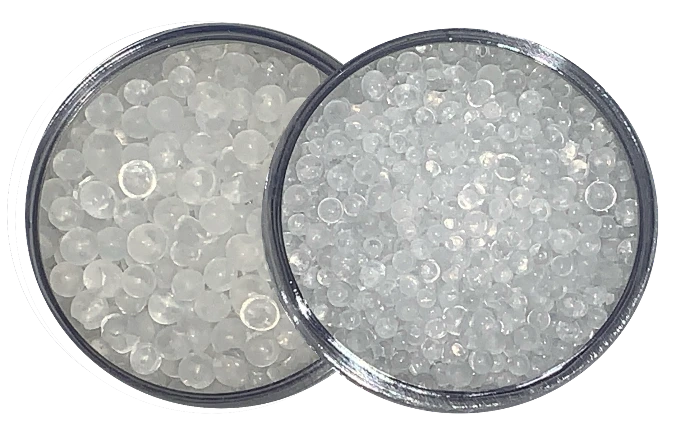
Desiccants are produced in various grain sizes. The choice of grain size affects adsorption properties and can be adjusted according to the intended application:
- Fine grains absorb moisture quickly but cause pressure drops and potentially more abrasion.
- Coarse grains absorb moisture more slowly but are significantly more stable – especially when exposed to high pressure.
Discover more